TOEFL writing sample answers: an email and a discussion post at bands 4, 5 and 6
Sample TOEFL iBT Writing answers for 2026: one email and one academic discussion post, each at band 4, 5 and 6, with their 0 to 5 points and the changes that move each one up a band.
Updated November 9, 2026 · 13 min read
The short answer
The 2026 TOEFL® iBT Writing section has two tasks you write yourself: Write an Email (7 minutes) and Write for an Academic Discussion (10 minutes). Each gets 0 to 5 points. Below is one original prompt for each task, answered at band 4, band 5 and band 6, with the points each answer earns, what it does, and the changes that would lift it to the next band. Build a Sentence, the third Writing task, has no sample answer because you write nothing, so it gets a short section at the end on what is scored.
How 0 to 5 points become a band
The two texts give up to 10 points and Build a Sentence up to 10 more, so the raw Writing score runs from 0 to 20, and it is that total, not any single answer, that becomes your Writing band from 1 to 6. There is no published table that turns one email's points into a band.
The old 0 to 30 Writing scale shows how high each band sits: band 6 is 29 to 30, band 5 is 24 to 26, and band 4 is 17 to 20. Our working rule, and the one used to label the answers here, follows from that:
| Band | CEFR | Points on each text | In practice |
|---|---|---|---|
| 6 | C2 | 5 | Every part of the task done well, almost no errors |
| 5 | C1 | 4, sometimes 5 | Clear, developed, a few slips |
| 4 | B2 | 3, sometimes 4 | The task done in part, with noticeable errors |
So a band 5 answer below is a strong 4, and a band 4 answer is a 3. Build a Sentence moves the section band too, so the same writing can end up in a band 5 section or a band 4.5 one.
What separates a 3, a 4 and a 5
The two tasks share most of their scoring guide, and each level is described in a few short lines. In plain terms:
| Points | Development | Language | Errors |
|---|---|---|---|
| 5 | Elaboration that effectively supports the purpose (email), or a relevant, very clear, well-elaborated contribution (discussion) | Effective variety of sentence structures; precise, idiomatic words | Almost none beyond typos under time pressure |
| 4 | Adequate elaboration; a relevant contribution that is easily understood | Variety, and appropriate word choice | Few |
| 3 | Elaboration that only partly supports the point; part of an explanation or example missing or unclear | A moderate range | Some noticeable errors in structure, word forms or idioms |
The email adds social conventions: politeness, register, and how a request or a criticism is put. At 5 they are consistent, at 4 mostly appropriate, and at 3 slips in them count among the noticeable errors.
Read each column from top to bottom. A 4 and a 5 differ by one word in each: adequate against effective, appropriate against precise, few against almost no. The step from 3 to 4 is mostly content and errors; the step from 4 to 5 is mostly polish.
Write an Email: the prompt
This prompt is original, written for this guide.
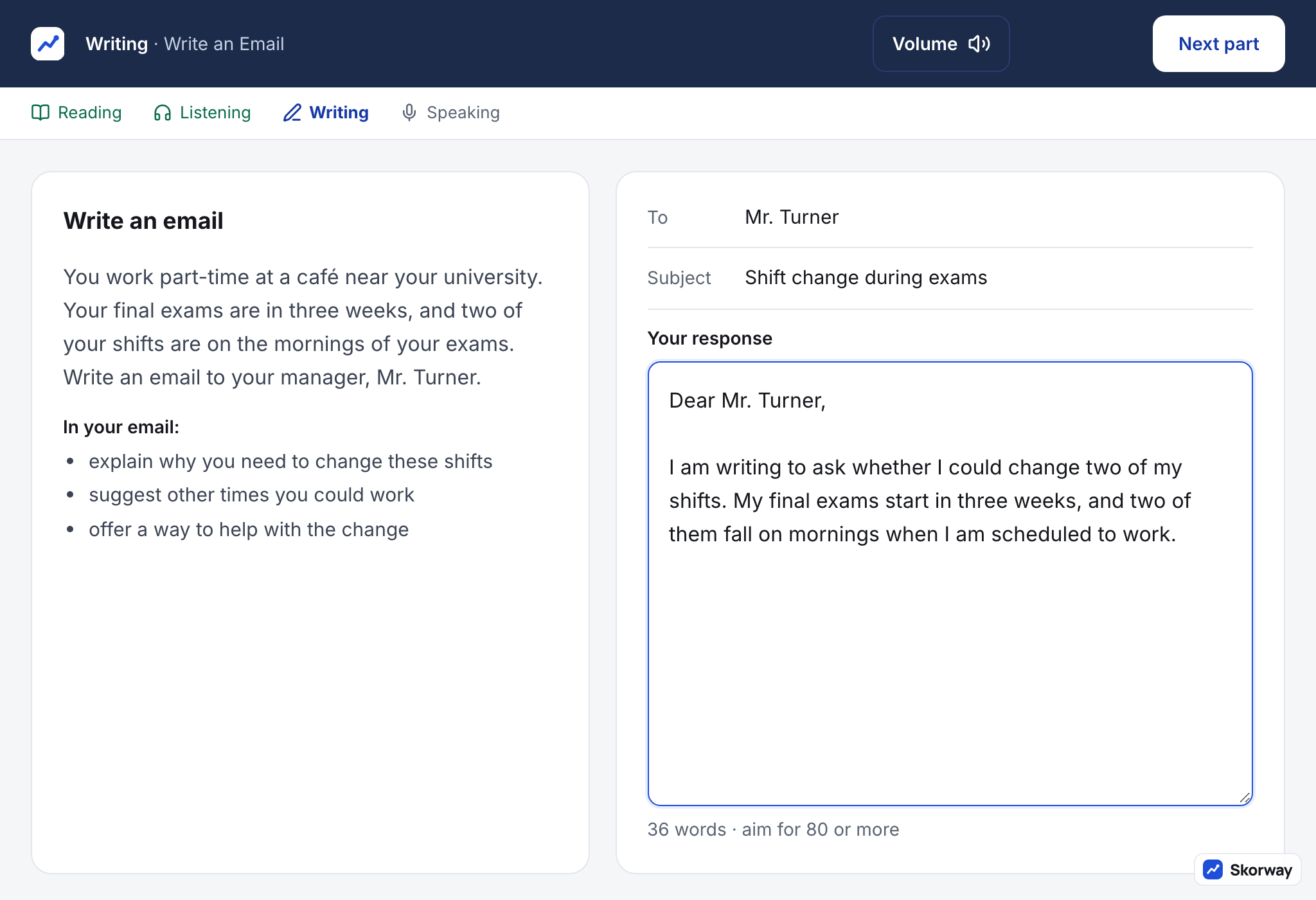
You are a member of your university's hiking club. The club's leader, Mr. Carter, has announced that the spring trip will move from a Saturday to a Wednesday, because the bus company charges less on weekdays. You have a lab class every Wednesday, and several other members do too.
Write an email to Mr. Carter. In your email, do the following.
- Tell him what you have enjoyed about the club's trips.
- Explain why the new day is a problem.
- Suggest another way to keep the cost of the trip down.
To: Mr. Carter · Subject: Spring trip date
The task is delicate on purpose: you are disagreeing with someone you want to stay on good terms with, and he had a reason for his decision. How you handle that reason is where the social conventions show.
Band 4 email (3 points)
Dear Mr. Carter,
I am member of hiking club since last year and I enjoy the trips very much. The views are beautiful and I meet many new friend.
But the new day is problem for me. I have lab class on Wednesday and I can't miss it because the professor take attendance. Also other members have classes too.
I think you should change the day back to Saturday. Maybe we can share cars, it will be cheaper.
Thank you,
Alex
About 80 words. What it does: it covers all three bullets in order, with a greeting and a sign-off, and every point is understood. That makes it a 3, not a 2. What holds it at 3:
- Errors you notice on a first read. I am member (no article), am … since last year (needs have been), many new friend, is problem, the professor take, and a comma splice in share cars, it will be.
- Thin elaboration. "The views are beautiful" could describe any club, and the suggestion does not say how sharing cars would work.
- A demand. "You should change the day back" ignores why he moved it.
To reach band 5 (a 4): fix the six errors above; give the first bullet one real memory; say how car sharing would save money; turn the demand into a request.
Band 5 email (4 points)
Dear Mr. Carter,
I have been a member of the hiking club since last fall, and the trips are the best part of my week. I especially enjoyed the trip to Bear Mountain in October, because the ranger explained a lot about the plants and animals there.
Unfortunately, the new day is a problem for me. I have a chemistry lab every Wednesday afternoon, and missing a lab is not allowed without a doctor's note. I know at least four other members who are in the same situation.
Instead of changing the day, maybe we could use a smaller bus, or members who has cars could drive. I would be happy to take three people in my car.
Best regards,
Alex
About 120 words. What it does: each bullet has its own paragraph and its own detail (Bear Mountain, a chemistry lab, an offer to drive). The sentences vary, and the register fits: Unfortunately softens the problem, and the suggestion is a maybe we could. What holds it at 4:
- One agreement error: members who has cars should be members who have cars.
- Correct but general words. Explained a lot about, is a problem for me and the same situation are fine; they are not precise.
- The leader's reason is never mentioned. He moved the trip to save money, and the email never shows it understood that, so its social conventions sit at the 4 level: mostly appropriate.
- The suggestion is not explained. Why would a smaller bus save money? The reader has to work it out.
To reach band 6 (a 5): fix has; acknowledge his reason before disagreeing; say what your plan would prevent; swap two or three general phrases for exact ones.
Band 6 email (5 points)
Dear Mr. Carter,
Thank you for all the work you put into planning the club's trips. The October hike to Bear Mountain was the highlight of my semester, partly because you arranged for a park ranger to walk with us and explain how the forest had recovered after the fire.
I understand why a weekday trip is cheaper, but Wednesday would be difficult for me. I have a chemistry lab that afternoon, and labs can't be made up later. At least four other members are in the same position, so the trip might end up with fewer people than usual.
Would it be possible to keep the Saturday date and cut costs another way? We could book a smaller bus and ask members with cars to drive the rest of the group. I'd be glad to take three people in mine.
Best regards,
Alex
About 150 words. What makes it a 5:
- It thanks before it disagrees, and the thanks is specific: a ranger, a fire, a forest that recovered.
- It names his reason first. "I understand why a weekday trip is cheaper, but…" is the single sentence that most separates this email from the band 5 one.
- The problem has a consequence that matters to him: fewer people on the trip.
- The request is a question, with the plan and the offer after it.
- Precise, idiomatic words: the highlight of my semester, can't be made up, end up with, cut costs.
- No errors.
The thirty extra words went into the acknowledgment and the consequence, and nothing else. For the screen, the scoring and a minute-by-minute plan, see our Write an Email guide.
Write for an Academic Discussion: the prompt
This prompt is original, written for this guide.
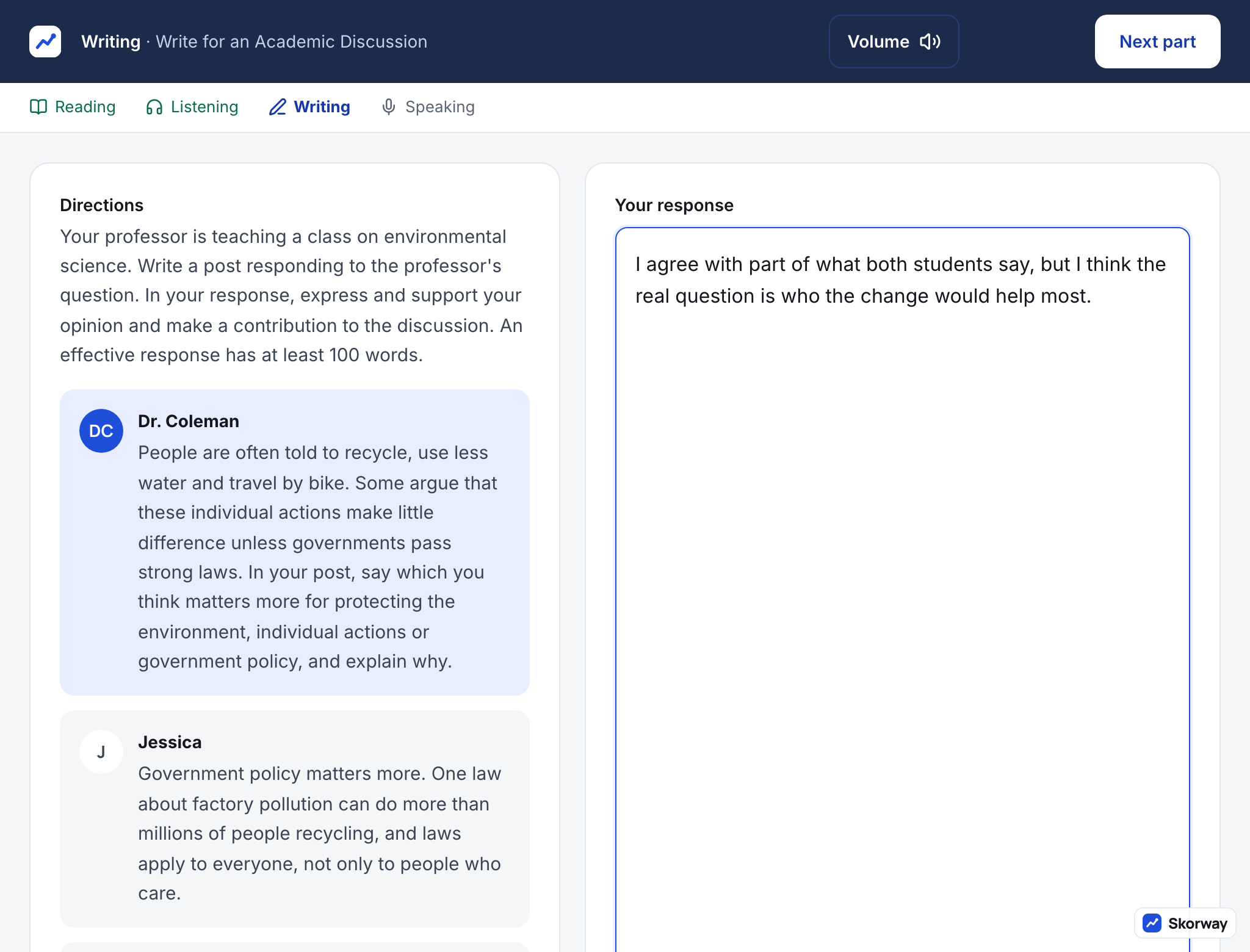
Dr. Bennett (Education): Many universities now record lectures and post them online, so students can watch them again or catch up after an illness. Some professors welcome this. Others say that when every lecture is online, attendance drops, and students fall behind because they plan to watch later and never do. Should universities record every lecture and make it available to students? Why or why not?
Emily: I think they should. I work twenty hours a week, and sometimes my shift overlaps with a class. Without recordings, I would miss that material completely. Recordings also help before exams, because you can replay the parts you didn't understand.
Jacob: I disagree. Last semester two of my courses were recorded, and by November half the room was empty. A lecture is not only information. You can ask questions and hear what other students are confused about, and a recording can't do that.
Both students make a good point. That makes the task harder: siding with one of them and repeating the reason adds nothing to the thread.
Band 4 post (3 points)
I agree with Emily that universities should record all lecture. Many students have a job and they cannot come to every class. For example my friend work in a restaurant at night and he is very tired in the morning, so recordings help him a lot. Jacob say that classroom become empty but I think this is the student's problem, not university. If student want to learn he will come to class. In conclusion, recording lectures is good idea because it help students who are busy.
About 85 words. What it does: a clear position, an example of its own and a reply to Jacob. What holds it at 3:
- No contribution. The main reason, students with jobs, is Emily's. The example repeats her post.
- Part of the explanation is missing. "This is the student's problem" dismisses Jacob's point without saying why he is wrong.
- Noticeable errors in verb endings and articles: all lecture, my friend work, Jacob say, classroom become, If student want, is good idea, it help.
- A memorized close that repeats the first sentence.
To reach band 5 (a 4): fix the endings and articles; replace "In conclusion" with a sentence that adds something; and find one idea neither student gave, such as a condition, a compromise or a cost.
Band 5 post (4 points)
I agree with Emily that lectures should be recorded, but Jacob's point about empty classrooms is also important. In my opinion, the best solution is to record lectures and give students another reason to attend. For example, professors could end each class with a short group activity that is not recorded. In my statistics course last year, the professor did this, and most students came every week even though the lectures was online. This way, students who work or get sick can still catch up, and the class keeps the discussion that Jacob values.
About 95 words. What it does: it engages both students, then makes a real contribution, a third option, supported by an experience of its own and tied back to both posts at the end. What holds it at 4:
- One agreement error: the lectures was online.
- The example is told, not explained. The post says students kept coming, not what the activity gave them that a recording could not.
- General phrasing. Is also important, the best solution and this way are appropriate, not precise.
- It is short for its idea. Under 100 words leaves no room to say why the activity works.
To reach band 6 (a 5): fix was; add one sentence on why the activity kept attendance up; and replace the general phrases with words that say exactly what you mean.
Band 6 post (5 points)
Both posts treat the recording as a replacement for the lecture, but I think the real question is what happens in the room that a camera cannot capture. Jacob is right that a recording is a weaker version of a live class: you cannot ask a question or notice that half the room looks lost. Yet Emily's situation is common, and penalizing students for a work shift seems unfair. Universities should therefore record every lecture but make class time worth attending. In my statistics course, the professor posted her lectures online and used class time for problems we solved in pairs, which were never recorded. Attendance stayed high all semester, because the hardest part of the course, applying the formulas, happened only in the room. Recording the explanation and keeping the practice live gives working students a fallback without emptying the lecture hall.
About 145 words. What makes it a 5:
- The first sentence reframes the question by naming the assumption both students share.
- It concedes before it proposes. Jacob is right that… Yet Emily's situation… Then the position, with therefore.
- The example is explained. The post says what was recorded, what was not, and why that kept people coming: "the hardest part of the course … happened only in the room."
- Precise words: a fallback, penalizing, keeping the practice live.
- Varied sentences with a purpose: a colon that introduces examples, an appositive (applying the formulas), a without phrase at the end.
- No errors.
The idea is the same as in the band 5 post. The difference is the sentence on why it works and the exactness of the words. For a line-by-line reading of another post at this level, see our annotated band 5 discussion post, and for the task itself the academic discussion guide.
Build a Sentence: what is scored
In Build a Sentence you put four to seven word chunks in order to make a reply, usually a question, to a short line. Only the order is scored: each of the ten items is 1 point if every chunk is in place and 0 if one is not. There is no partial credit, and no style or spelling to judge. Here is one item:
A: I have a meeting with the dean at three.
B:
___ ___ ___ ___ ?Chunks: is / do you know / her office / where
The correct order is "Do you know where her office is?". The same four chunks also build "Do you know where is her office?", the question order inside an embedded question, and that scores 0. One chunk out of place costs the whole point.
Those ten points are half the raw Writing score, as much as the email and the discussion together, so two more correct items are worth as much as raising both texts from a 3 to a 4. Our Build a Sentence guide has five items to try and a method for each.
How long should a TOEFL writing answer be?
There is no maximum and no word count for the email. The discussion instructions say an effective response has at least 100 words. Aim for 100 to 150 words in the email and 120 to 150 in the discussion post: the band 6 answers above are about 150 words each.
Can I memorize sample answers for the TOEFL?
Memorize shapes, not sentences. A memorized paragraph does not fit a new prompt, and a post that does not answer the professor's question cannot be a relevant contribution, however good its English. What you can carry into the test is the order of an email (thanks or context, problem, request), the habit of naming a classmate and adding something new, and a final two-minute check of verb endings and articles.
Do spelling mistakes lower the TOEFL writing score?
A few do not. A 5 allows the kind of slips a competent writer makes under time pressure, such as a common typo or there for their. Errors that change word forms or sentence structure (he work, is good idea) are what pull an answer down to a 3.
Write one, then see your band
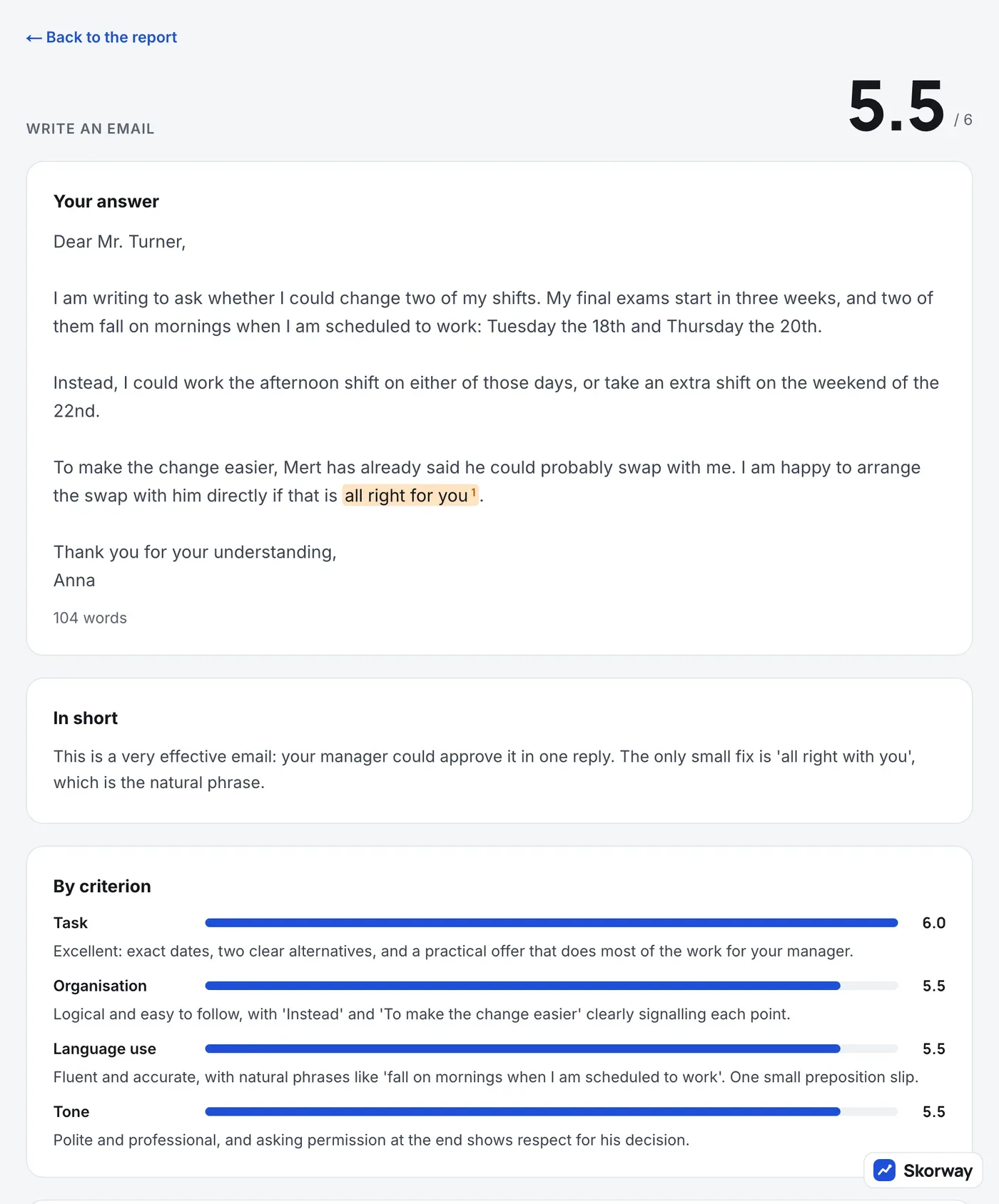
Seeing the difference between a 4 and a 5 in someone else's writing is easy. Seeing it in your own is harder, because your errors are the ones you do not notice. Write the email in 7 minutes and the post in 10, compare them with the samples here, then take a Skorway mock to see where your writing stands on the real clocks. It is the full 2026 test, and its Writing section runs Build a Sentence, the email and the discussion on their clocks of 6, 7 and 10 minutes. Your email and post are each scored twice, independently, with a third pass when the two disagree, and come back with a band for each criterion, your errors quoted with corrections, and the text rewritten one band higher, so the next band is a list of sentences to change. A few minutes after the mock you have a Writing band on the 1 to 6 scale and a band for every other section. If you have not seen the Writing screens yet, start with the free Test Tour: the whole TOEFL test at your own pace.
Correct for the TOEFL iBT as it runs on November 9, 2026.