The TOEFL Writing section in 2026: three tasks, 23 minutes, and how it is scored
TOEFL Writing since January 2026: Build a Sentence, Write an Email and the academic discussion, 12 items in 23 minutes, how it is scored, and a practice plan.
Updated November 7, 2026 · 8 min read
The short answer
The TOEFL® Writing section has three task types since January 21, 2026: Build a Sentence (10 items), Write an Email (one email) and Write for an Academic Discussion (one post). That is 12 items in about 23 minutes, on three separate clocks of 6, 7 and 10 minutes. Build a Sentence is half of the raw Writing score and each of the two texts is a quarter. The raw score becomes a Writing band from 1 to 6. Writing is the third section, after Listening and before Speaking, and it is not adaptive: everyone gets the same 12 items.
The three tasks at a glance
| Task | Items | Time | What you do | Scored |
|---|---|---|---|---|
| Build a Sentence | 10 | about 6 minutes | Put word chunks in order to make a reply to a short line | 1 or 0 each |
| Write an Email | 1 | 7 minutes | Write an email that does three things listed as bullets | 0 to 5 |
| Write for an Academic Discussion | 1 | 10 minutes | Add your view to a class discussion, after a professor and two students | 0 to 5 |
Each task has its own clock. Time you save on Build a Sentence does not carry over to the email, and the email's seven minutes end whether you have signed off or not.
Build a Sentence: ten items in six minutes
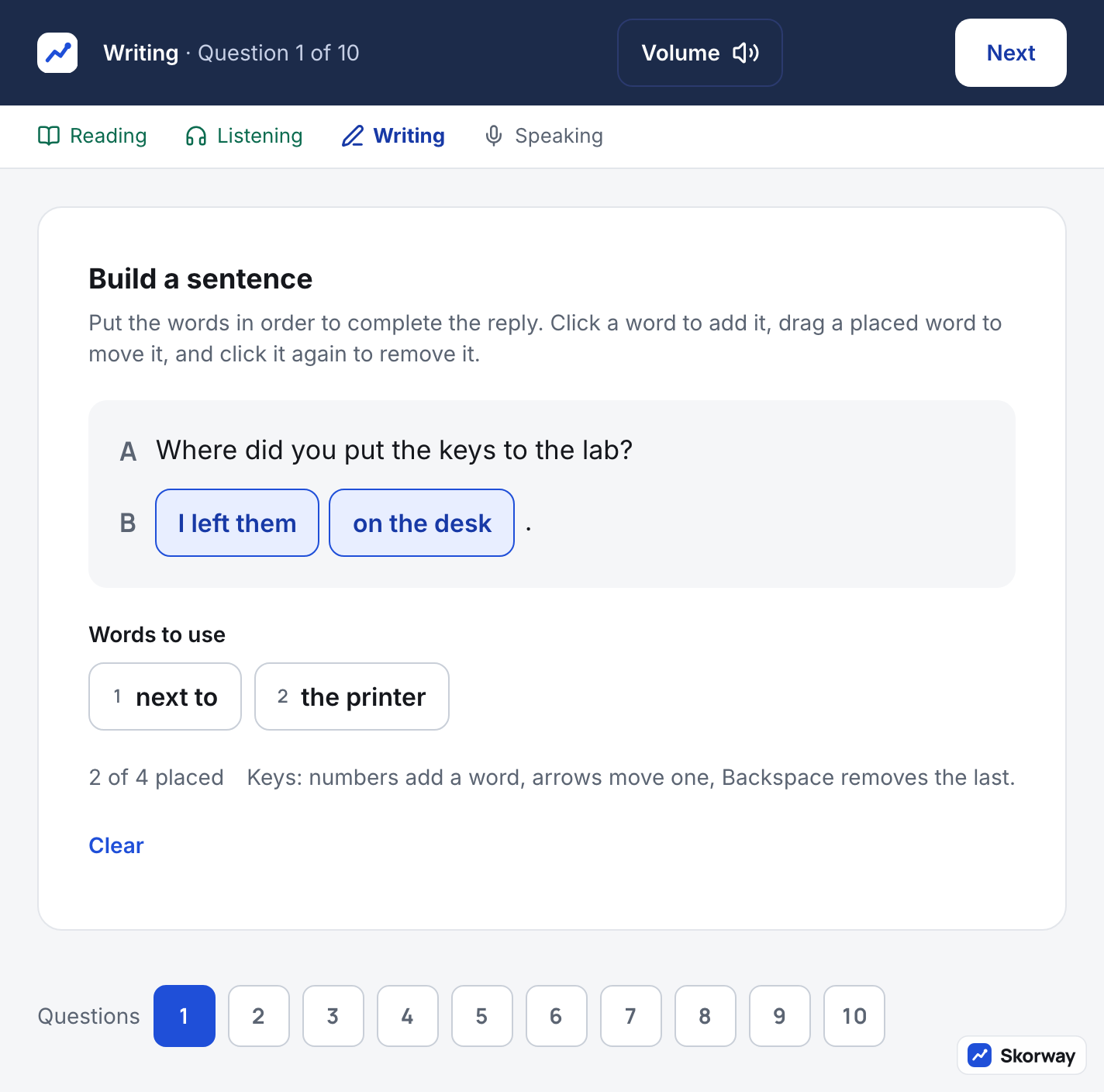
Speaker A says something ordinary ("I'm thinking about joining a gym near my office."). Below it is speaker B's reply as a row of blanks, with the end punctuation and sometimes a word or two already in place, and under that four to seven chunks of one to three words. You click the chunks into the blanks. Every chunk is used once, and only one order is correct.
Most replies are questions, which is the point of the task: it tests the word order English speakers get right without thinking and learners get wrong under pressure. "How much does the membership cost?", "Have you asked her for her email address yet?", "Do you know when it opens again?" The last of those is the trap that catches most people: after "do you know when", the order is a statement's, "it opens", not "does it open".
All chunks are in lower case, so the first word is not given away. Each item is right or wrong, with no partial credit, and ten items in six minutes leaves about 35 seconds each. Our Build a Sentence guide has five items to try in the page and a method for each one.
Write an Email: seven minutes, three bullets
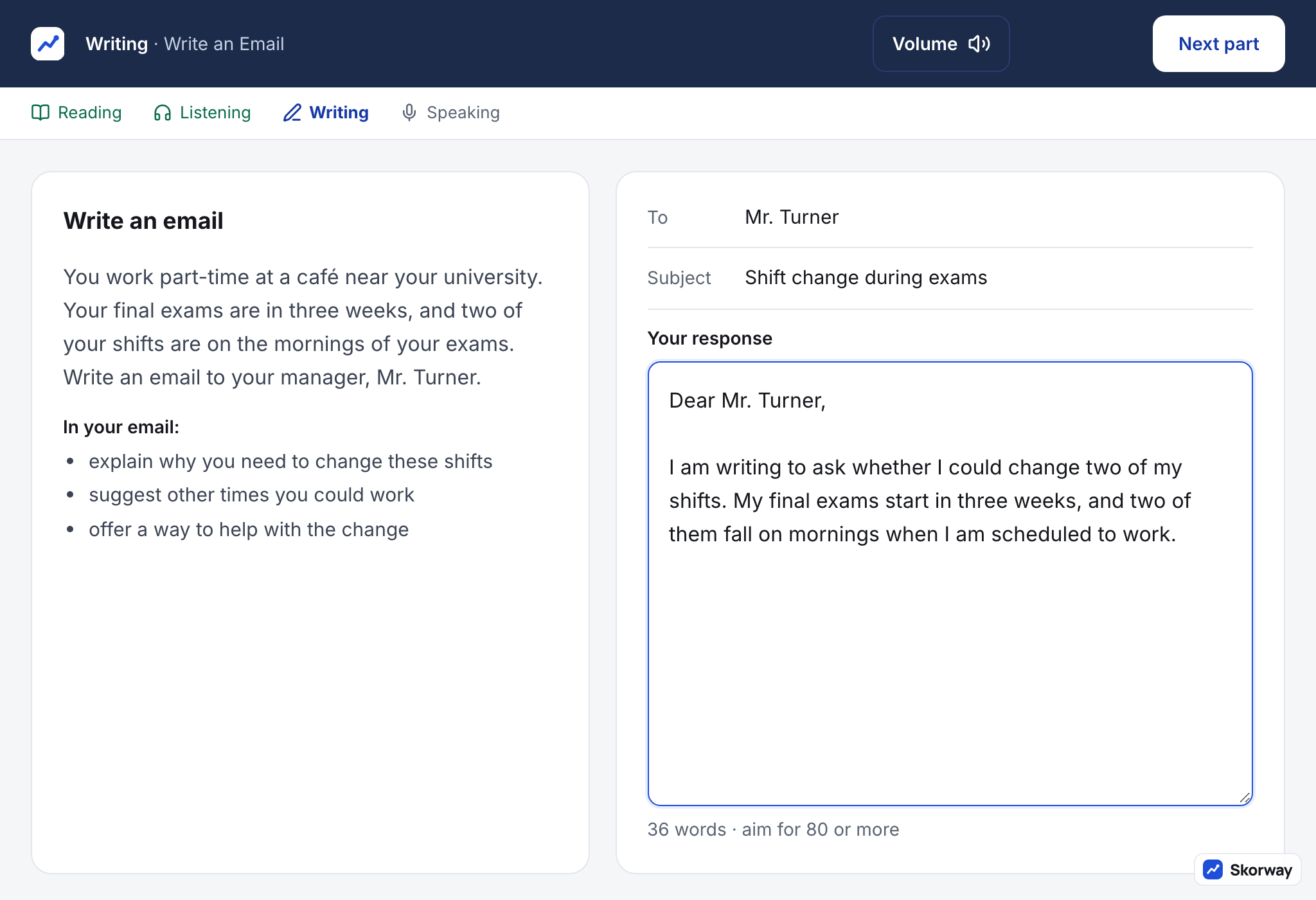
A scenario of three or four sentences tells you who you are writing to and why: thanking a neighbor, reporting a problem to a landlord, giving feedback to an organizer, asking a professor for something. Three bullets say what the email must do, each starting with a verb (Tell, Describe, Explain, Suggest, Ask). The To and Subject lines are filled in for you; you write the body.
The email is scored from 0 to 5 on the Writing scoring guide. A 5 covers all three bullets with real detail, varies its sentences, uses precise words and keeps the social conventions: a greeting and a sign-off, a register that fits the reader, a request made as a request. Aim for 100 to 150 words. The Write an Email guide has a sample prompt, a model answer and a minute-by-minute plan.
Write for an Academic Discussion: ten minutes, at least 100 words
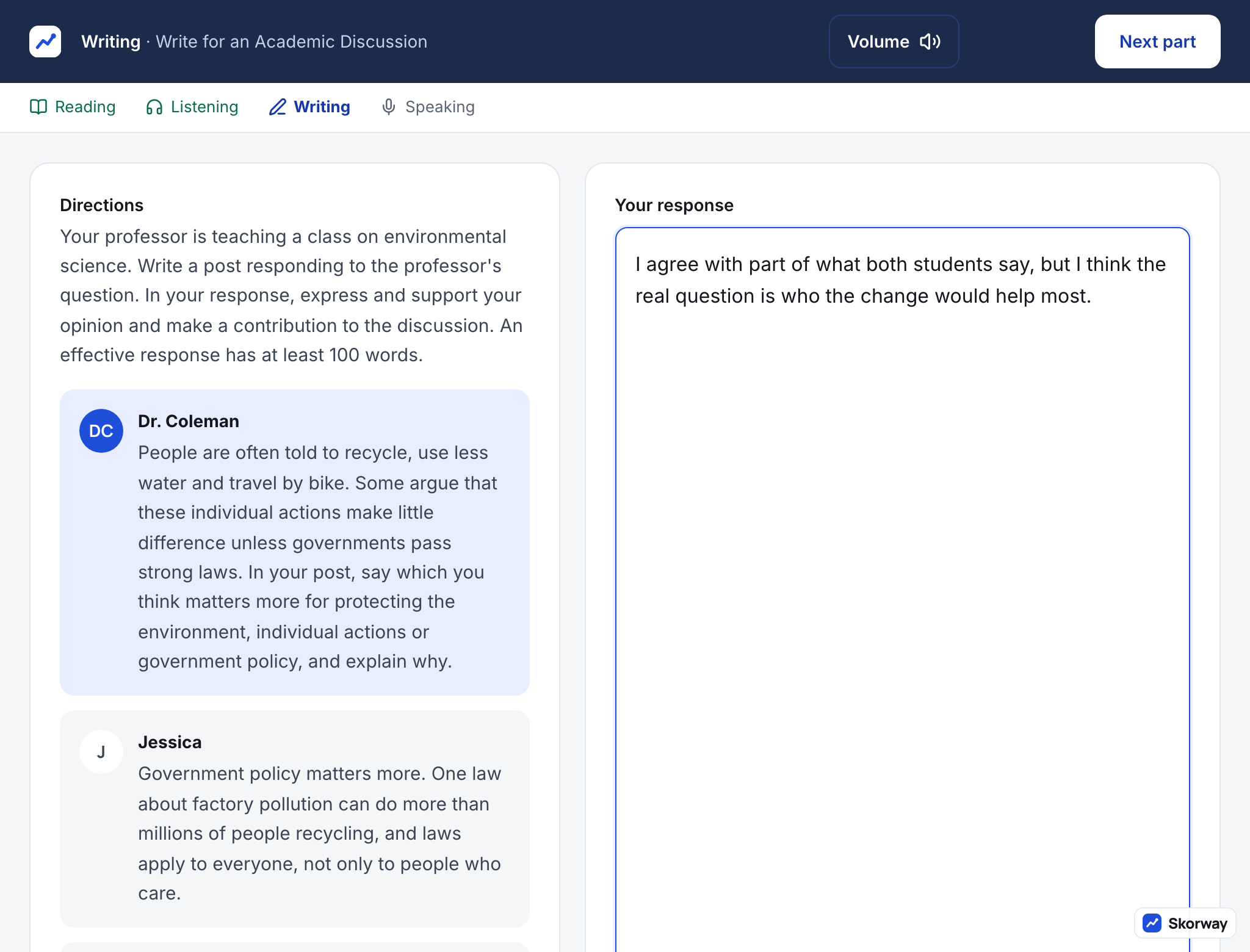
A professor posts a question to an online class, two students reply with different views, and you write the third post. The instructions ask for your opinion, supported, and "a contribution to the discussion in your own words". An effective post has at least 100 words; most strong posts are 120 to 150.
The difference between a 4 and a 5 is almost always the contribution. Agreeing with one of the students and repeating their reason adds nothing to the thread. A new reason, an example from your own experience, or a condition under which the other view would be right does. The academic discussion guide has a band 6 post and three ways to contribute, and the annotated band 5 post goes line by line.
How the section becomes a band
The raw Writing score runs from 0 to 20:
- Build a Sentence: one point per correct item, 10 in all, half of the section.
- Write an Email: 0 to 5, a quarter.
- Write for an Academic Discussion: 0 to 5, a quarter.
The raw score is then converted to a Writing band from 1 to 6 in half steps, and that band counts as one quarter of your overall band. Build a Sentence is marked by key. The email and the discussion post are scored by an AI scoring engine trained on human ratings, with human raters overseeing it. In the field test the automated and human Writing scores agreed closely, and Writing was as reliable as Reading and Listening.
The weighting changes how you should spend practice time. Ten Build a Sentence items are worth as much as both texts together, and they are the fastest to improve, because the same handful of question patterns comes back on every test. Two more correct sentences, from 6 to 8, are worth as much raw score as lifting both texts from a 3 to a 4.
What changed from the old Writing section
Until January 2026, Writing had two tasks: Integrated Writing, a 20-minute summary of a reading passage and a lecture, and the academic discussion. The integrated task is gone, and nothing in the new section asks you to read or listen before you write. The academic discussion stayed, on the same 10-minute clock. Build a Sentence and the email are new. The section is shorter, from about 30 minutes to about 23, and it comes before Speaking instead of after it. Our guide to what happened to Integrated Writing covers what to keep from old books and what to drop.
A practice plan for the Writing section
- Build a Sentence first, on the clock. Ten items in six minutes, every day for a week. Note which patterns you miss (embedded questions, the present perfect with "yet", "who" as subject) and drill those.
- One email a day. Seven minutes, timed. Check afterwards that each bullet has its own paragraph and its own detail, and that the greeting and sign-off fit the reader.
- Three discussion posts a week. Ten minutes each. Before writing, decide in one line what you add that neither student said.
- One full Writing section a week, all 12 items in a row, so the switch between clocks is familiar on test day.
How long is the TOEFL Writing section in 2026?
About 23 minutes: about 6 minutes for the ten Build a Sentence items, 7 minutes for the email and 10 minutes for the academic discussion.
How many questions are in TOEFL Writing?
Twelve: ten Build a Sentence items, one email and one academic discussion post.
Is the TOEFL Writing section adaptive?
No. Reading and Listening adapt to how you do in their first part; Writing and Speaking are the same for everyone on a test form.
Is there still an essay on the TOEFL?
Not in the old sense. The longest text you write is the academic discussion post, with a 100-word minimum on a 10-minute clock. The 30-minute independent essay went in 2023 and the integrated essay in January 2026.
See your Writing band before test day
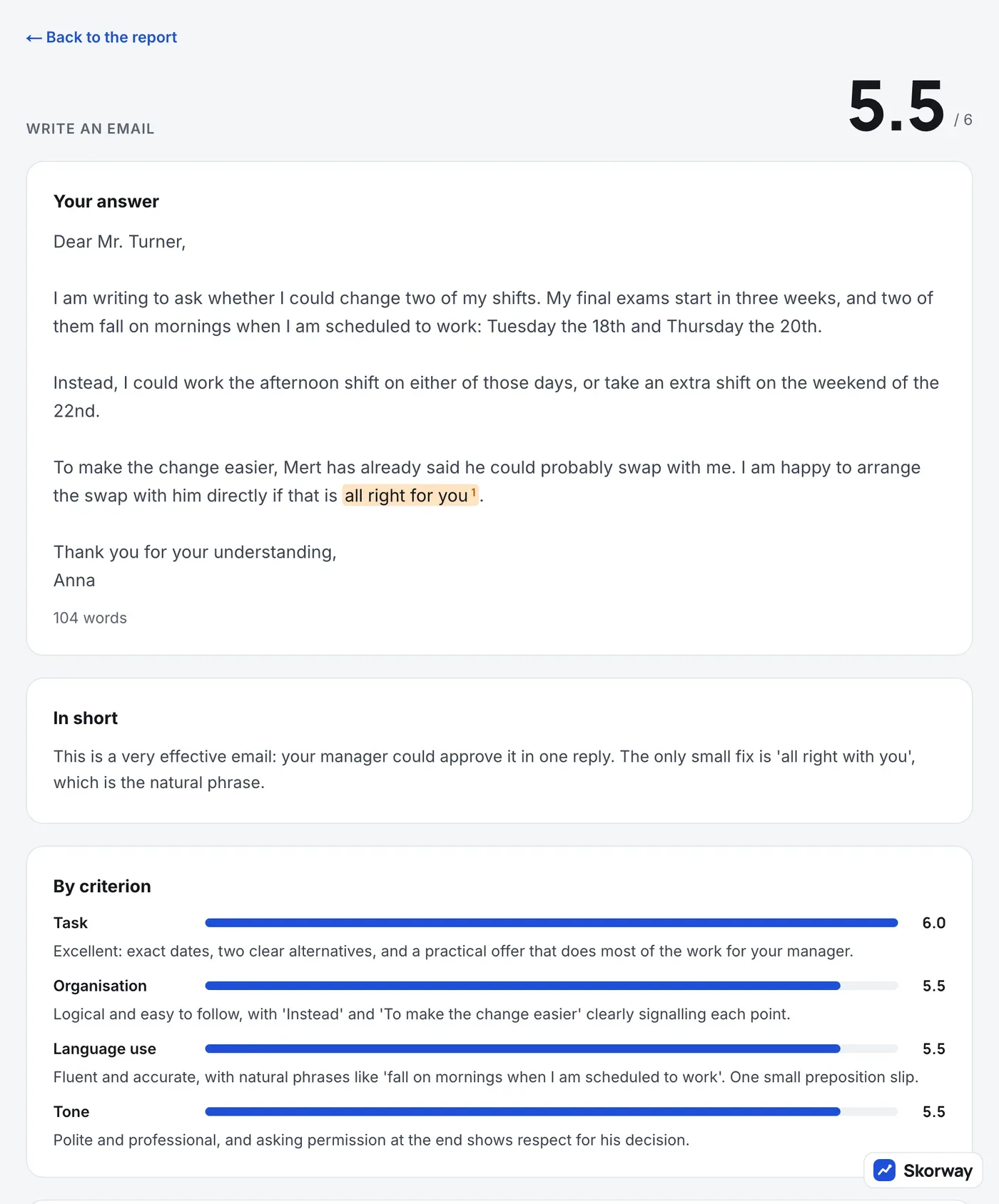
Twelve items on three clocks is easy to describe and harder to pace. Skorway's free Test Tour has the Writing section exactly as above, ten Build a Sentence items, the email and the discussion post, at your own pace. A mock puts each on its real clock. Your email and post are each scored twice, independently, with a third pass when the two disagree, and come back with a band for every criterion, your errors quoted with corrections, and the text rewritten one band higher. The report lists every Build a Sentence item with what you built and the correct sentence. A few minutes after the mock you have a Writing band on the 1 to 6 scale and a band for every other section. The Writing practice sets cover each task on its own, and the first two sets of every task type are free with an account.
Correct for the TOEFL iBT as it runs on November 7, 2026.