TOEFL Write for an Academic Discussion: the format, the scoring and a band 6 answer
TOEFL Write for an Academic Discussion in 2026: the forum format, 10 minutes and 100 words, the scoring, three ways to contribute, and a band 6 answer.
Updated 6 November 2026 · 8 min read
The short answer
Write for an Academic Discussion is the last Writing task on the 2026 TOEFL® iBT. You see an online class forum: a professor's post that ends in a question, and replies from two students who disagree. You write your own post that gives and supports your opinion and adds something to the discussion. You have 10 minutes, and an effective response has at least 100 words. The post is scored from 0 to 5 and is worth a quarter of the raw Writing score. It is the one task carried over unchanged from the test before 2026.
What you see on screen
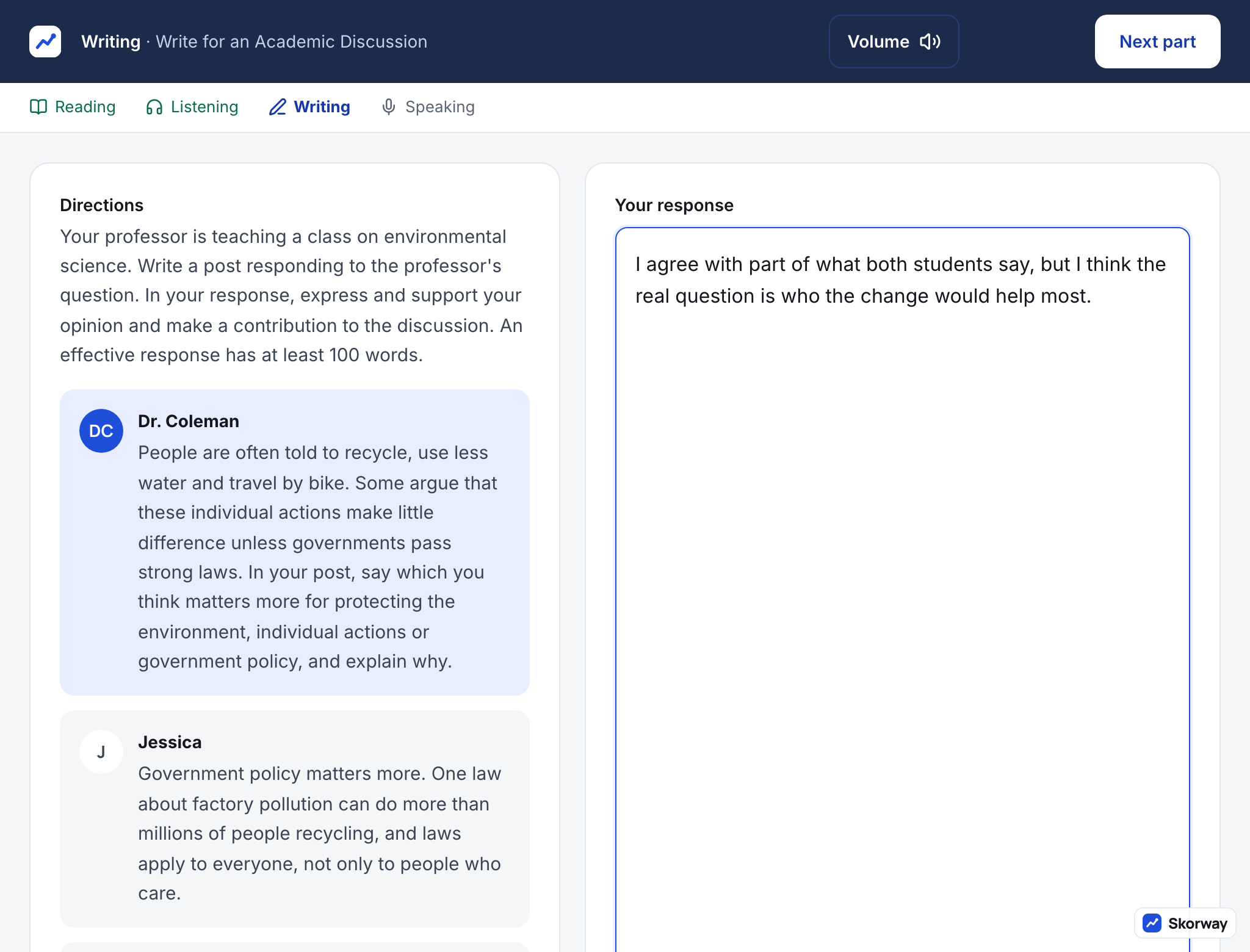
On the left: "Your professor is teaching a class on [subject]. Write a post responding to the professor's question." Then two instructions, to express and support your opinion and to make a contribution to the discussion in your own words, and the line "An effective response will contain at least 100 words." Below, the professor's picture, name and post. On the right, the two students' pictures and first names with their posts, and the writing box with a word count.
The professor's post is about 55 to 80 words: a line or two of background, the tension between two views, and a direct question ending "Why?" or "Why or why not?". Each student writes 30 to 50 words, one on each side, with a reason. The topics come from education, technology, psychology, business, the environment and health, and none needs specialist knowledge.
How it is scored
A 5 on the Writing scoring guide is a relevant and very clearly expressed contribution to the discussion, with well-elaborated explanations, examples or details, a variety of sentence structures, precise and idiomatic words, and almost no errors. The key word is "contribution". Raters look for ideas that add to the discussion, and memorised answers score low because they do not fit the topic.
The post is scored by an AI scoring engine, with human raters in the process. A 3 is mostly relevant with part of the explanation missing or unclear; a 1 has few coherent ideas and relies on language borrowed from the prompt.
Three ways to contribute
Agreeing with one student and repeating their reason is not a contribution, however well it is written. Three moves are:
- A new reason. Take a side, and give a reason neither student gave.
- A condition or a compromise. "Yes, but only if…" or a third option that keeps what is right in both posts.
- An example that tests a claim. A specific case from your experience that shows one student's reason is stronger or weaker than it looks.
Try it
Your professor is teaching a class on education.
Dr. Rivera: Many universities now record their lectures and post them online, so students can watch them later. Supporters say this helps students review difficult material and catch up when they are sick. Others worry that students stop coming to class when they know the lecture will be online. Should universities record every lecture? Why or why not?
Emily: Yes, they should. I learn better when I can pause and replay a difficult explanation. Some of my classmates work part-time, and recordings are the only way they can keep up with the course.
Tyler: I'm not sure. When I know a lecture is recorded, I tell myself I'll watch it later, and then I never do. Being in the room keeps me focused, and I can ask questions right away.
Give yourself 10 minutes, then compare.
A band 6 answer
Both Emily and Tyler describe something real, but I think the problem Tyler describes comes from how recordings are used, not from the recordings themselves. Universities should record lectures, but they should also change what happens in the room. If part of every class were spent on activities that cannot be recorded, such as short group problems or questions for the professor, students would still have a reason to attend, while the recordings would remain available for review. My chemistry course already works this way: the professor posts the lecture online, but the last twenty minutes of each class are for solving problems in pairs, and most of us still come every week. This approach keeps the benefit Emily mentions for students who work or get sick, without turning the lecture hall into an empty room.
About 140 words. What makes it a 6:
- It contributes. The move is the second one above: it accepts Emily's point, explains Tyler's in a new way, and proposes a third option.
- It engages both students by name, and says something about each that they did not say themselves.
- The example is specific: one course, twenty minutes, problems in pairs. It shows the idea works instead of asserting it.
- The language is precise and varied: a second conditional, "while" for contrast, "without turning…" to close. There are no errors.
For a band 5 answer to a different prompt, annotated sentence by sentence, see the band 5 academic discussion guide. It shows exactly what separates a 5 from a 6.
A 10-minute plan
| Minutes | What to do |
|---|---|
| 0 to 1 | Read the question twice and both posts once. |
| 1 to 2 | Choose your move: a new reason, a condition or an example. |
| 2 to 8 | Write: your position, a line on one or both students, your contribution, one specific example, a closing sentence. |
| 8 to 10 | Check verb endings, articles and agreement. |
Mistakes that keep posts at 3 or 4
- Summarising the students. Names are useful only when you add something.
- Borrowing their sentences. Use your own words; the scoring guide marks borrowed language down.
- A memorised opening. Pre-written answers score low because they do not fit the topic.
- Reasons without an example. One developed example beats three listed reasons.
- Stopping short of 100 words. Below that, there is rarely room for real elaboration.
See your Writing band before test day
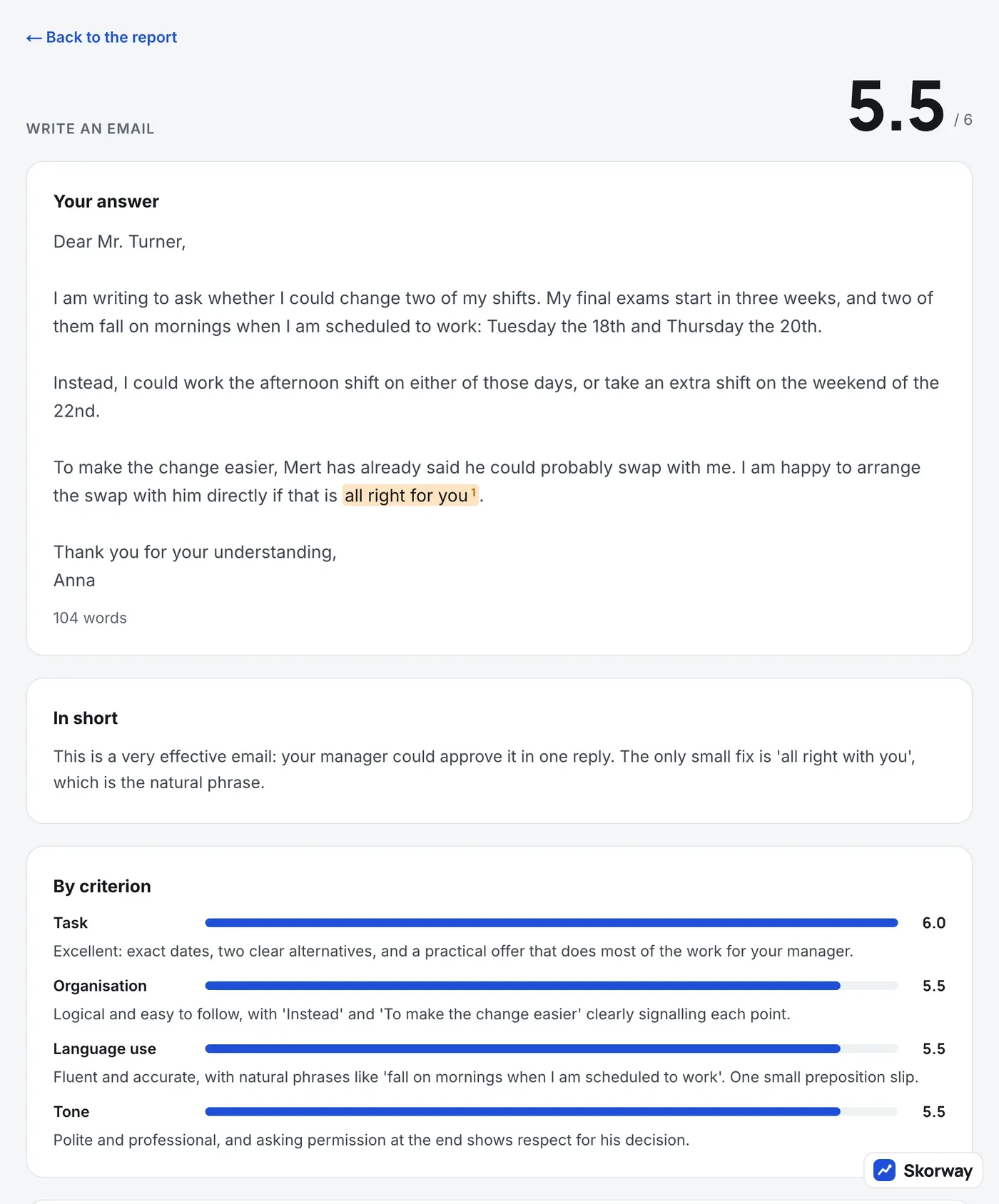
The academic discussion is a quarter of the Writing score, and the difference between a 4 and a 5 is one idea and one example, which is easy to fix once someone shows you which one was missing. Skorway's free mock is the full 2026 test, with the discussion on its real 10-minute clock after Build a Sentence and the email. Your post is scored twice, independently, with a third pass when the two disagree, and comes back with a band for each criterion, your errors quoted with corrections, and the post rewritten one band higher. A few minutes after the mock you have a Writing band on the 1 to 6 scale and a band for every other section. The Writing practice sets have more discussion prompts, and the first two sets of every task type are free. No credit card.
How many words should the TOEFL academic discussion be?
At least 100, as the screen says. There is no maximum; aim for 120 to 150 words, which leaves room for a reason and a specific example in 10 minutes.
Can I agree with one of the students?
Yes, as long as you add something: a new reason, a condition or an example. Agreeing and repeating their reason in other words is not a contribution.
Did the academic discussion change in 2026?
No. It is unchanged from the old test. Practice from before 2026 still counts, and only the band it feeds into, now on the 1 to 6 scale, is new.
Correct for the TOEFL iBT as it runs on 6 November 2026. TOEFL® is a registered trademark of ETS. Skorway is not endorsed or approved by ETS.