TOEFL vocabulary for 2026: the academic words by level, and where the test uses them
TOEFL vocabulary for the 2026 test: the academic words that matter from B1 to C2, where each task tests them, how to learn them, and why there is no PDF.
Updated November 10, 2026 · 9 min read
The short answer
The 2026 TOEFL® iBT tests vocabulary in all four sections, and the words it leans on are general academic ones, not rare ones: require, interpret, consequently, constrain, plausible. Complete the Words asks you to spell the second half of a word. Read an Academic Passage asks what a word means in one particular sentence. Speaking and Writing are scored partly on the range and precision of your words. Skorway's vocabulary builder has nearly 2,500 of these words in sets of up to 20, sorted by CEFR level from B1 to C2 and by topic. It is online, with flashcards and a quiz, and there is no PDF. Learn the level just above your band first, a set at a time, and come back to the words you miss.
Academic words, not GRE words
The texts on the test are the kind a student meets at school or in a first university course: a passage of about 200 words on history, art, business or science, a 70-word paragraph about owls or ice cores, an email from a landlord, a short talk from a biology class. No background knowledge is needed, and the Complete the Words paragraphs avoid jargon. So the vocabulary that pays is the vocabulary those texts share: verbs for what researchers do, words for cause and change, linking words, words for claims and evidence.
A list built for a graduate admissions test is the wrong list. Words like pusillanimous or obstreperous take as long to learn as diminish or whereas, and they turn up far less often. Learn the common academic words first and well, and the rare ones only once those are solid.
The words by level
The vocabulary builder sorts its words by CEFR level, the same scale your TOEFL band is built on. Each level has sets by topic: everyday academic verbs, core nouns, describing and evaluating, linking words, research and study skills, and subject sets from biology and earth science to economics, history and law.
| Level | TOEFL band | Words in the builder | Examples |
|---|---|---|---|
| B1 | 3 to 3.5 | about 270 | require, identify, rely, vary, approximately, gradually, therefore, reliable, survey, pattern |
| B2 | 4 to 4.5 | about 530 | analyze, interpret, assess, indicate, emerge, sufficient, significant, consequently, nevertheless, whereas |
| C1 | 5 to 5.5 | about 670 | allocate, derive, facilitate, constrain, diminish, ambiguous, prevalent, hence, conversely, concede |
| C2 | 6 | about 1,000 | mitigate, deviate, permeate, refute, premise, empirical, intrinsic, arbitrary, fluctuate, alleviate |
B1: the words every task leans on
High-frequency academic words that appear in almost every text on the test: method, source, issue, role, feature, involve, achieve, select. The linking words matter as much as the content words. Therefore, meanwhile, eventually and on the other hand tell you how two sentences relate, and a question about that relation is a question you can answer only if you know them.
B2: the verbs of academic work, and the linkers that turn an argument
Here are the verbs that describe what a text or a researcher does: establish, interpret, assess, demonstrate, distinguish, emphasize, account for, carry out. The B2 linkers mark a turn in the argument, and a reader who misses one misreads the whole paragraph: nevertheless, whereas, in contrast, despite, ultimately. B2 is also where the words for change arrive: transform, shift, expand, alter, abandon, bring about.
C1: the words that carry an argument
C1 words are less common, and each one carries meaning a simpler word would lose: constrain, trigger, sustain, undergo, accumulate, hypothesis, variable, biased, flaw. The C1 argument set is the one to know cold for Reading and for the discussion post: imply, acknowledge, concede, contradict, plausible, coherent, compelling, consensus, underlying. Fixed expressions begin at this level too: factor in, stumble upon, be inclined to.
C2: precision and nuance
At C2 the difference is precision: a word chosen for a shade of meaning, such as tenuous for an argument that barely holds, or vindicated for an idea shown to be right long after it was first put forward. These are words like infer, refute, premise, rationale, inherent, dubious, unwarranted, exemplify and mitigate, and phrases borrowed whole into academic English: status quo, de facto, carte blanche. A learner at band 5 meets most of them as readers; using them well in a 45-second answer is what band 6 sounds like.
Where vocabulary shows up in each task
| Task | How it tests words | What that asks of you |
|---|---|---|
| Complete the Words | You type the missing second half of every second word in a paragraph | Spell the word exactly, with the right ending |
| Read in Daily Life | Notices, emails and schedules in everyday language | Know the words of rules, requests and exceptions |
| Read an Academic Passage | "The word X in the passage is closest in meaning to" | Pick the meaning in this sentence, not the most common one |
| Listening | Formulaic phrases in short replies; academic words in talks | Recognize words at speaking speed, heard once |
| Writing | Email and discussion are scored partly on varied, precise, idiomatic word choice | Use the right word, not only a correct one |
| Speaking | The interview is scored partly on the range and accuracy of your vocabulary | Have words ready without stopping to search |
Complete the Words: spelling counts
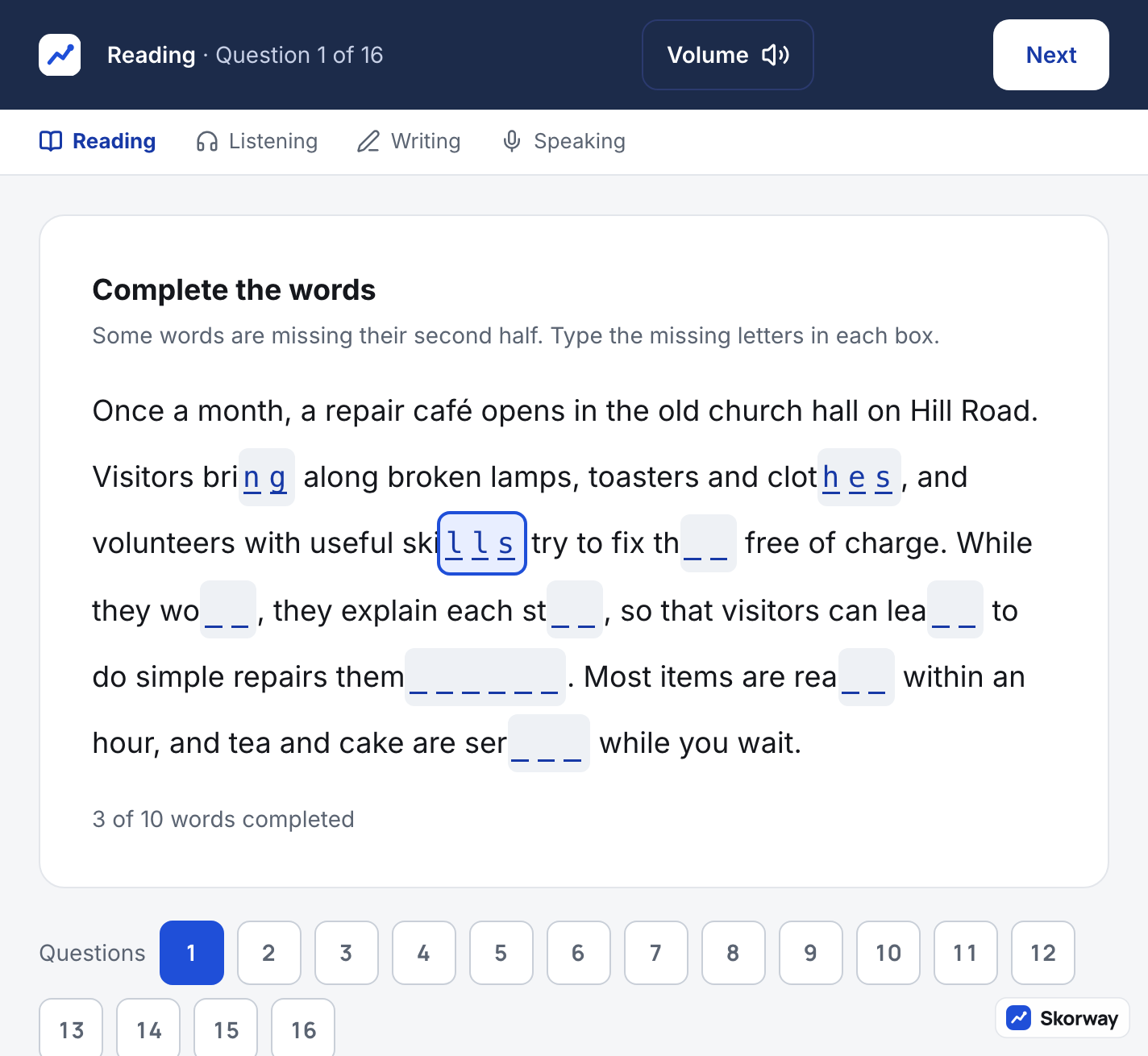
Every Reading module opens with a paragraph in which the second half of every second word is missing, and only the exact letters score. Recognizing accumulate on a page is not enough when the screen shows "accum _ _ _ _ _" and you have to type the rest. In our own C1 paragraphs the gaps include successive, suspended, atmospheric, preserves and noticeably: ordinary academic words, but long ones, with endings that have to be right. The Complete the Words guide explains the cutting rule.
Read an Academic Passage: the meaning in this sentence
Vocabulary in context is one of the five question types in the passage task. The options are single words or short phrases, and the wrong ones are related words that fit the topic. In one of our practice passages, about selling ice before refrigerators, the question asks what declined means in "The business declined only when machines that made ice, and later home refrigerators, became cheap and reliable." The options are refused, changed, moved and decreased. Refused is a real meaning of decline, the one most learners know first, and it is wrong here: a business that declines gets smaller. Put each option into the sentence and read it; the Read an Academic Passage guide has the other traps.
At the higher levels the tested words get harder and the options closer. Our C2 passages ask about vindicated, austere and squandered, where two options are near in meaning and only one fits the writer's point.
Speaking and Writing: range and precision
Writing's email and discussion post are scored from 0 to 5, and a 5 needs precise, idiomatic word choice alongside varied sentences. Our annotated band 5 discussion post shows the difference in practice: obstacle and targeted approach are precise, this is the reason why is correct but loose. In the interview, a 3 has a limited range that gets in the way of saying exactly what you mean, and a 5 has a range of accurate grammar and vocabulary. Machine scoring looks at the same thing from another angle: how varied your words are, how common they are, and whether they combine the way English speakers combine them.
Range here does not mean rare words. It means not saying good five times when useful, effective and reliable each say something different.
How to learn them: spaced review
Words stick when you meet them again just before you forget them. The plan below is ours, and it is built around that.
- Start one level above your band. If your last mock gave you a 4 (B2), the C1 sets are your main list, with the B2 sets as a quick check of what you already know. Words two levels up are mostly ones you will not need yet.
- One set a day, at most two. Twenty words is a round you can finish in ten minutes and repeat the next day. Fifty words a day feels productive and leaves very little behind.
- Flashcards first, then the quiz. In the builder, each card shows the word; you say the meaning to yourself, show it, and mark "I knew it" or "Still learning". The quiz then gives you the definition and asks for the word, which is the harder direction and the one Speaking and Writing need.
- Come back on a schedule. Aim to review a set the next day, three days later and a week later. The builder remembers every answer and puts the words you missed first in the next round, so each return is shorter than the last.
- Learn the word in its sentence. Every word in the builder has an example sentence written for a student, such as Many students rely on the campus shuttle to get to their part-time jobs downtown. The sentence gives you the grammar around the word: rely on, not rely to.
- Spell it once. For each word you mark as known, type it out or write it down without looking. Complete the Words gives no points for a word you can only recognize.
- Use two new words a day. Put them into a 45-second spoken answer or a short paragraph. A word you have used once comes back much faster under the clock.
Learn the families as you go. Suspect, suspected and suspicion are one entry in your head and three different gaps on the test.
Is there a TOEFL vocabulary PDF?
Not from us. Skorway's vocabulary builder is online, and that is deliberate: a PDF cannot tell you which twelve of the twenty words you already knew, and the builder does, because it keeps every answer and brings the missed words back first. You need a Skorway account to open it. The first set, everyday academic verbs at B1, is free, and the rest come with a pass.
If you like paper, keep a notebook of the words you miss in the builder, with the example sentence copied out by hand. That list will be shorter and far more useful than a 2,000-word printout.
How many words do you need for the TOEFL?
No word count guarantees a band. What counts is whether you know the common academic words well enough to spell them, use them and understand them in a sentence you hear once. If your target is a 5, aim to know the B1 and B2 sets thoroughly and most of C1 by test day. The rest of the score comes from reading and listening skill, grammar and fluency.
Does the TOEFL use GRE words?
The test is built from school and university texts, everyday emails and campus conversations, and its words are the ones those texts use, so a GRE list is poor value for the time it takes. The harder passages do ask about less common words. In our own C2 practice those are words like austere and squandered, which a well-read student knows, not entries chosen for their rarity.
Are there vocabulary questions on the TOEFL 2026?
Yes. Read an Academic Passage asks what a word or phrase is closest in meaning to, as the old test did, and Complete the Words is a vocabulary task from start to finish. Every Reading module opens with one of those paragraphs, so 20 of the 35 scored Reading points depend on knowing and spelling words.
See which words are costing you points
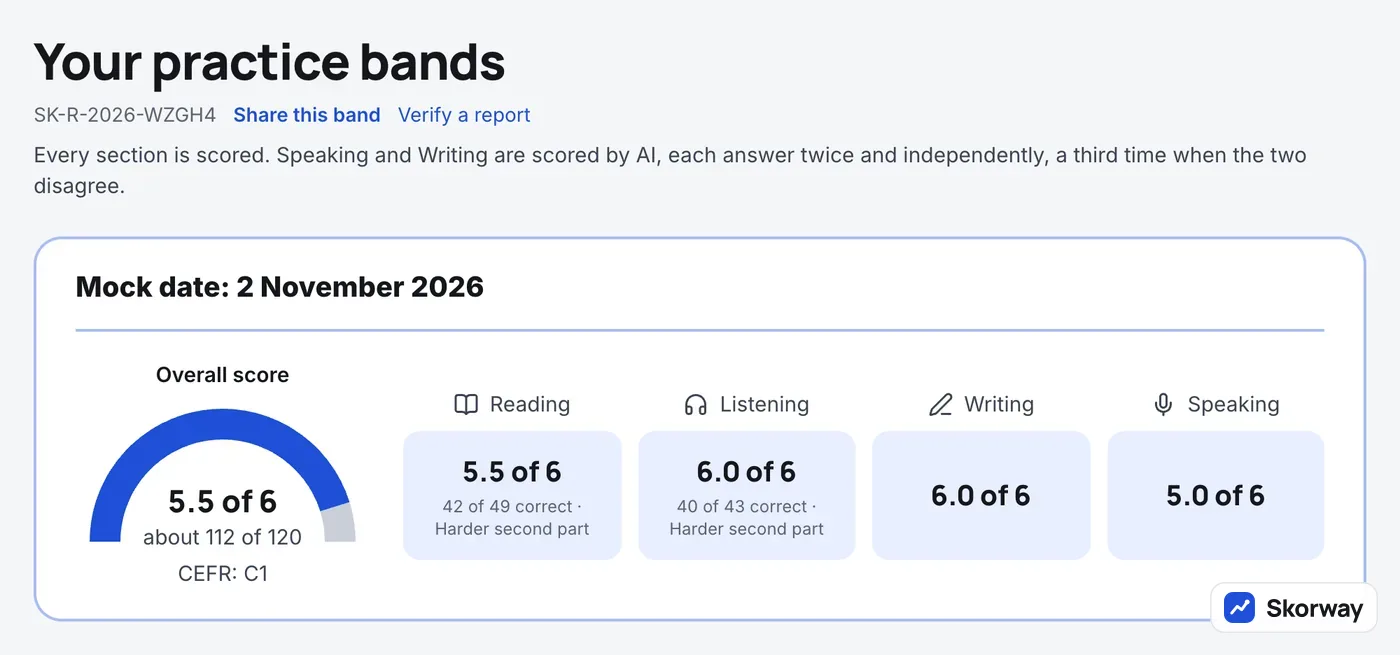
A word list tells you what you could learn; a mock tells you what you need. A Skorway mock is the full 2026 test on the real clocks, with the Complete the Words paragraphs marked letter by letter. A few minutes after you finish you have a band for every section and a report that names the three task types that cost you the most. Every Speaking and Writing answer comes back marked up and rewritten one band higher, which shows you the exact words a stronger answer would have used, often the ones in the next level's sets. To see the tasks first, the free Test Tour is the whole TOEFL test at your own pace, with every Reading screen as the test shows it.
Correct for the TOEFL iBT as it runs on November 10, 2026.