TOEFL Complete the Words: how the 2026 task works, with a practice paragraph
TOEFL Complete the Words in 2026: the 10-gap paragraph, the rule for which letters are cut, how it is scored, a practice paragraph with answers, and the traps.
Updated 6 November 2026 · 7 min read
The short answer
Complete the Words is the first task of the 2026 TOEFL® iBT. You see one paragraph of about 60 to 90 words. The first sentence is whole; after it, the second half of every second word is missing, until there are 10 gaps, and one or two whole sentences close the paragraph. You type the missing letters, one per slot. Each gap is worth 1 point, and only the exact letters score. Every Reading module opens with one of these paragraphs, so 20 of the 35 scored Reading questions are Complete the Words: more than half the section.
What you see on screen
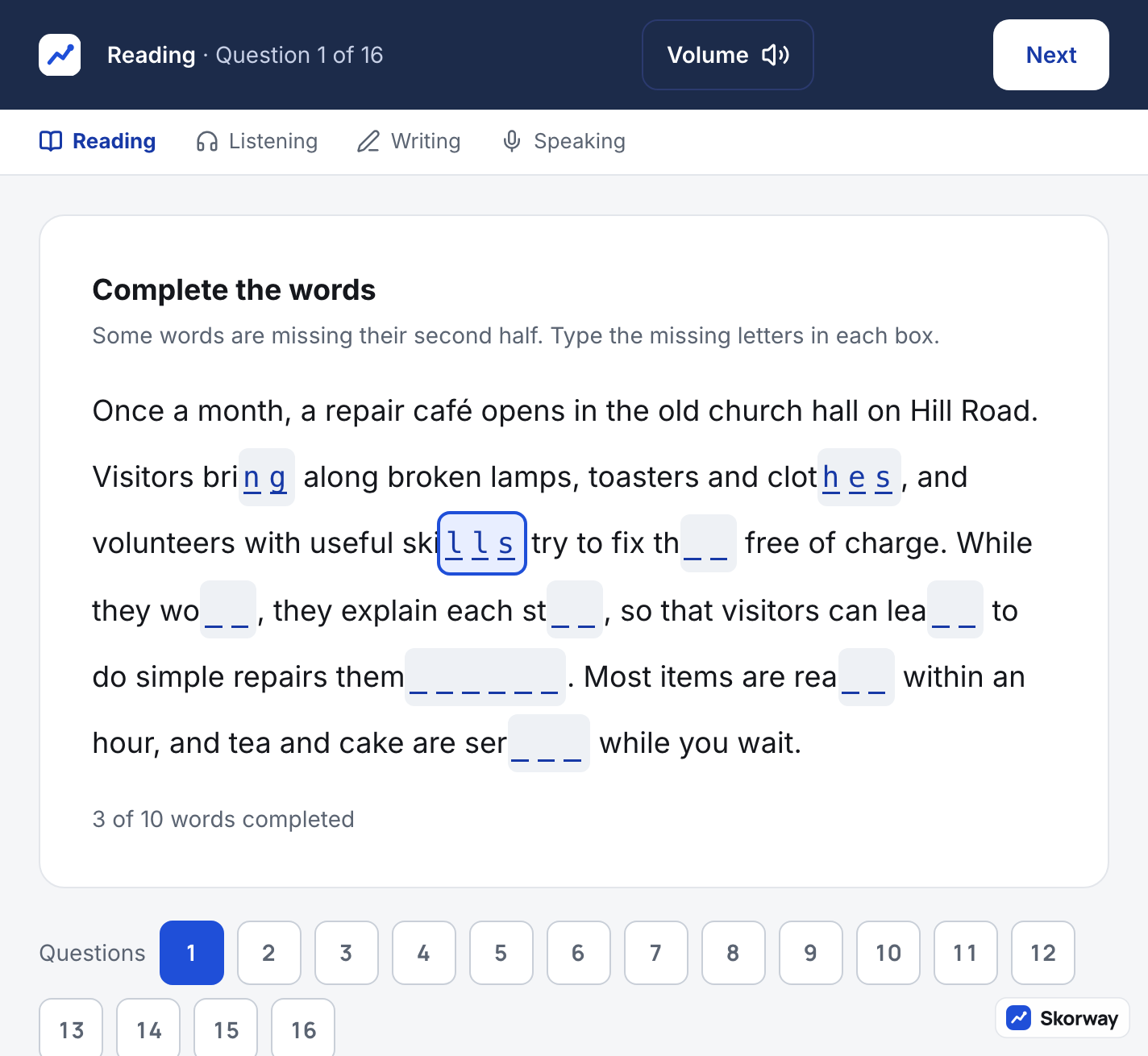
The title is "Fill in the missing letters in the paragraph." Below it, the paragraph, with a row of short boxes wherever letters are missing: one box per letter. You click a gap and type. The paragraph stays on screen with the rest of the module, and the module has one clock for everything in it, so there is no separate timer for this task.
The task is to complete partially missing words. It tests reading for meaning and form at the same time: vocabulary, word order, grammar and comprehension of the paragraph around each gap.
The rule for which letters are cut
The rule is mechanical, and knowing it turns every gap into a smaller puzzle.
- Which words: from the second sentence on, every second word, starting with the second word of that sentence. One-letter words such as "a" and "I" are skipped.
- Which letters: the first half of the word stays, rounded down, and the rest is cut. A word of 4 letters keeps 2; a word of 5 keeps 2; a word of 7 keeps 3.
| Word | You see | You type |
|---|---|---|
| in | i _ | n |
| the | t _ _ | he |
| show | sh _ _ | ow |
| these | th _ _ _ | ese |
| animals | ani _ _ _ _ | mals |
| information | infor _ _ _ _ _ _ | mation |
So the number of boxes tells you the length of the whole word: count the letters shown, add the boxes, and you know exactly how long the word is. A word that fits the meaning but not the count is wrong.
Try it
Type the missing letters, one per box, then check your answers.
Octopuses are among the cleverest animals in the sea, and scientists have studied them for decades. In aqua, they ha learned t open ja, escape fr their ta and ev recognize t people w feed th. Much of an octopus's nervous system sits in its eight arms. Each arm can taste and touch what it holds, almost as if it had a small brain of its own.
What the paragraph was testing:
- Grammar decides the last gap. "th _ _" could be "they", "then", "this" or "them" by the letters alone. After "feed", only an object fits, so it is "them".
- Meaning decides "ta _ _ _". Five letters starting "ta" could be "tanks", "tasks" or "talks". Only one is something an octopus escapes from.
- The small words are half the points. "t _", "fr _ _", "w _ _" and "t _ _" are function words. They look easy, and they are, but only if you read the sentence instead of guessing letter by letter.
- The closing sentences are there for you. They are whole, and they often confirm a gap you were unsure of. Read to the end of the paragraph before you settle the last few.
The traps
- A real word of the wrong length. "jar" fits "ja _ _" by meaning but leaves a box empty. Count the boxes.
- The wrong ending. Plural -s, past -ed and third-person -s are where most points go. "they ha _ _ learned" needs "have", not "has", because "they" is plural.
- A word that fits the gap but not the sentence. Read the words on both sides of the gap, not only the letters before it.
- Spelling. The answer is the exact letters. "recieve" for "receive" scores nothing.
- Leaving a gap blank. There is no penalty for a wrong answer, so a guess that fits the letters and the grammar is always better than nothing.
How it is scored
Each gap is 1 point, marked automatically by the answer key; a paragraph is worth 10. Reading's first part has 10 scored Complete the Words gaps and the second part has 10 more, whichever second part you are routed to, so the task is 20 of the 35 scored Reading points. Because the first part decides which second part you get, the first paragraph of the test is the one gap-by-gap accuracy matters most on. The whole Reading section then becomes a band from 1 to 6, as the Reading guide explains.
How to practise it
- Read the whole first sentence twice. It is the only sentence you get complete, and it tells you the topic.
- Fill the function words first (the, and, of, to, from), then the content words, then go back for anything left.
- Say the sentence in your head with the word in it. If it sounds wrong, it probably is.
- Practise on real paragraphs. Take any short English text, cover the second half of every second word from the second sentence on, and fill it in the next day.
See your Reading band before test day
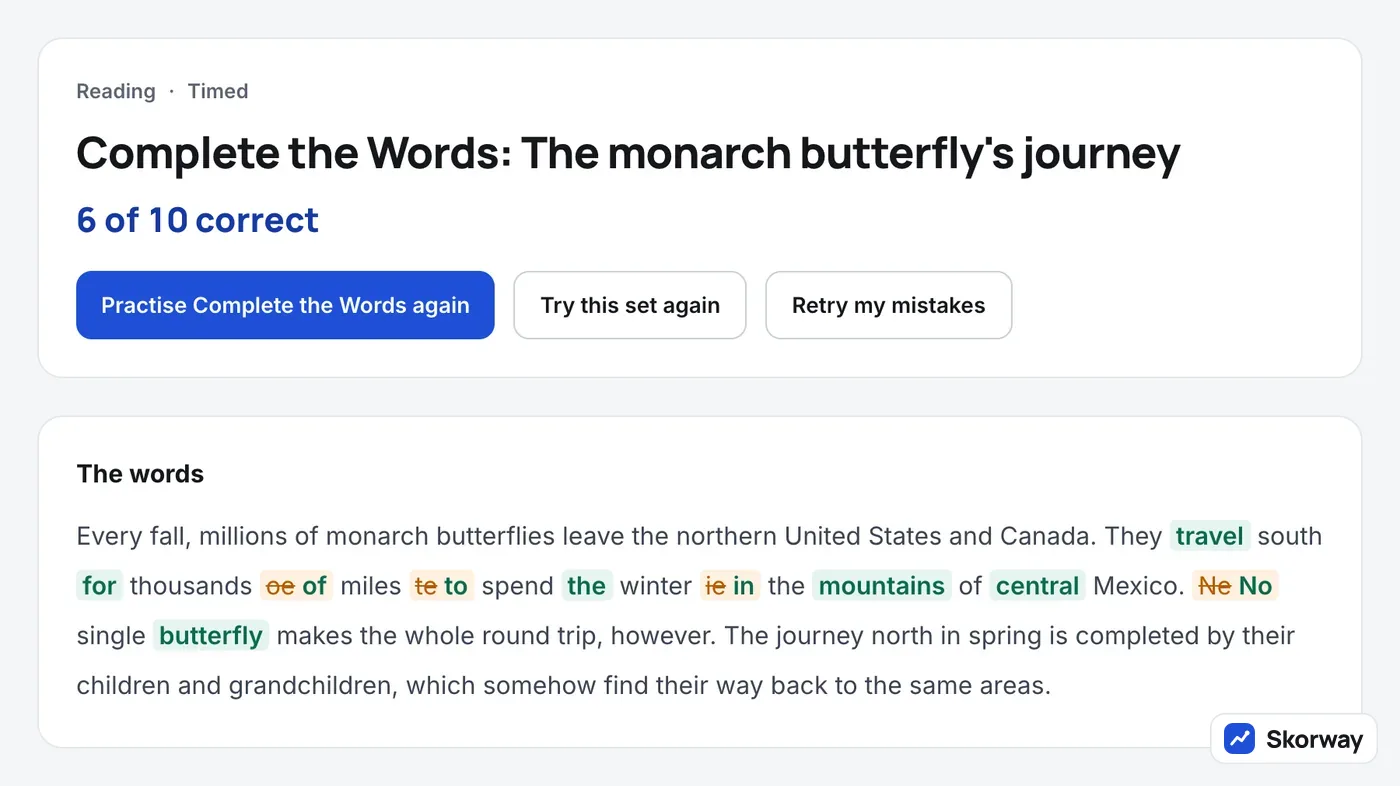
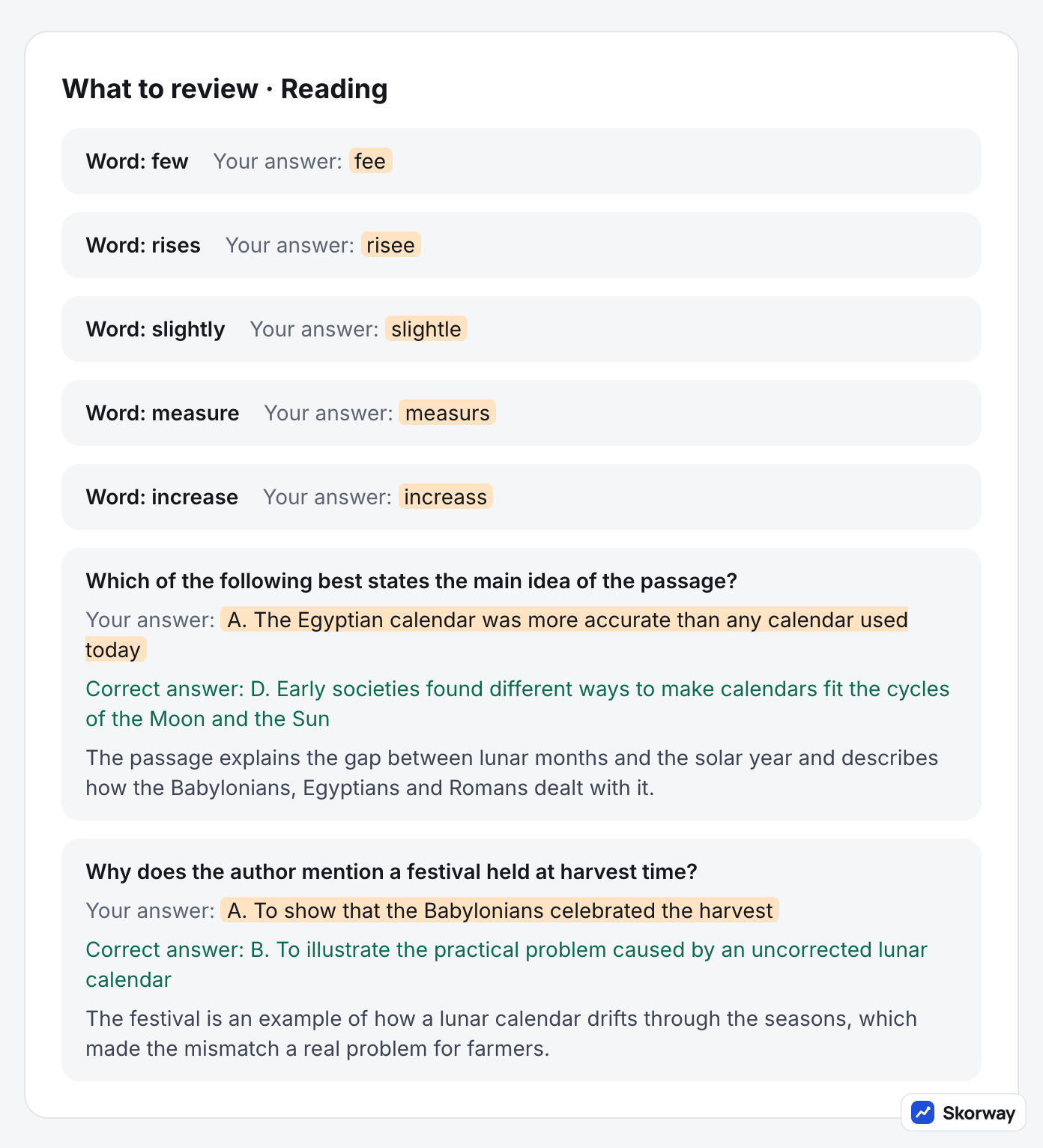
Complete the Words is half of the Reading points, and it is also the task most learners have never seen before 2026. Skorway's free mock is the full 2026 test, so you meet these paragraphs the way the test gives them: at the start of each Reading part, on the module clock, with the boxes and the exact-letter marking. Reading is marked as soon as the section ends, and a few minutes after the whole mock you have a band for every section and a report that names the three task types that cost you the most. If Complete the Words is one of them, the Reading practice sets have more paragraphs, and the first two sets of every task type are free. No credit card.
How many Complete the Words questions are on the TOEFL?
Twenty that count: one paragraph of 10 gaps in each Reading part. A test can hold up to 30 Complete the Words items, so a third paragraph is possible; any items beyond the 20 that count are unscored tryouts, and they look exactly like the others.
Does spelling count in Complete the Words?
Yes. Only the exact missing letters score, so a misspelt word is a wrong answer even if the meaning is right.
How much time do you get for Complete the Words?
There is no separate clock. The paragraph shares the module clock with the other Reading tasks, and the whole section is about 30 minutes for up to 50 questions. Give a paragraph about three minutes, so the rest of the module keeps its time.
Correct for the TOEFL iBT as it runs on 6 November 2026. TOEFL® is a registered trademark of ETS. Skorway is not endorsed or approved by ETS.