TOEFL Read an Academic Passage: the question types, with a sample passage
TOEFL Read an Academic Passage in 2026: the 200-word passage, the five questions and how each type works, a sample passage with answers, and the traps.
Updated 6 November 2026 · 8 min read
The short answer
Read an Academic Passage is the third Reading task on the 2026 TOEFL® iBT. You read a passage of about 200 words in three paragraphs, on a subject such as history, art, business, life science, physical science or social science, and answer 5 questions about it. The passage stays on screen while you answer. No background knowledge is needed: everything is in the text. Each question is 1 point, marked automatically. Everyone gets one passage in Reading's first part, and a second only in the harder second part.
What changed from the old passages
The old TOEFL had two passages of about 700 words with 10 questions each. The 2026 passage is less than a third of that length, with half the questions, and it sits beside two other task types. The skills tested are the same ones, main ideas, details, vocabulary, inference and the author's purpose, but in a text you can read twice in two minutes. That changes the strategy: reading the whole passage first is now cheap, and it pays.
The passage
The passage is an expository text typical of secondary school or university, and most passages follow one shape:
- Paragraph 1 introduces an idea or a phenomenon and why it matters.
- Paragraph 2 gives a complication, a problem or the evidence.
- Paragraph 3 gives a response: a solution, a new finding or an example that extends the idea.
Knowing the shape answers questions before you read them. A question about the relationship between paragraphs 2 and 3 is very often "a solution to the problem".
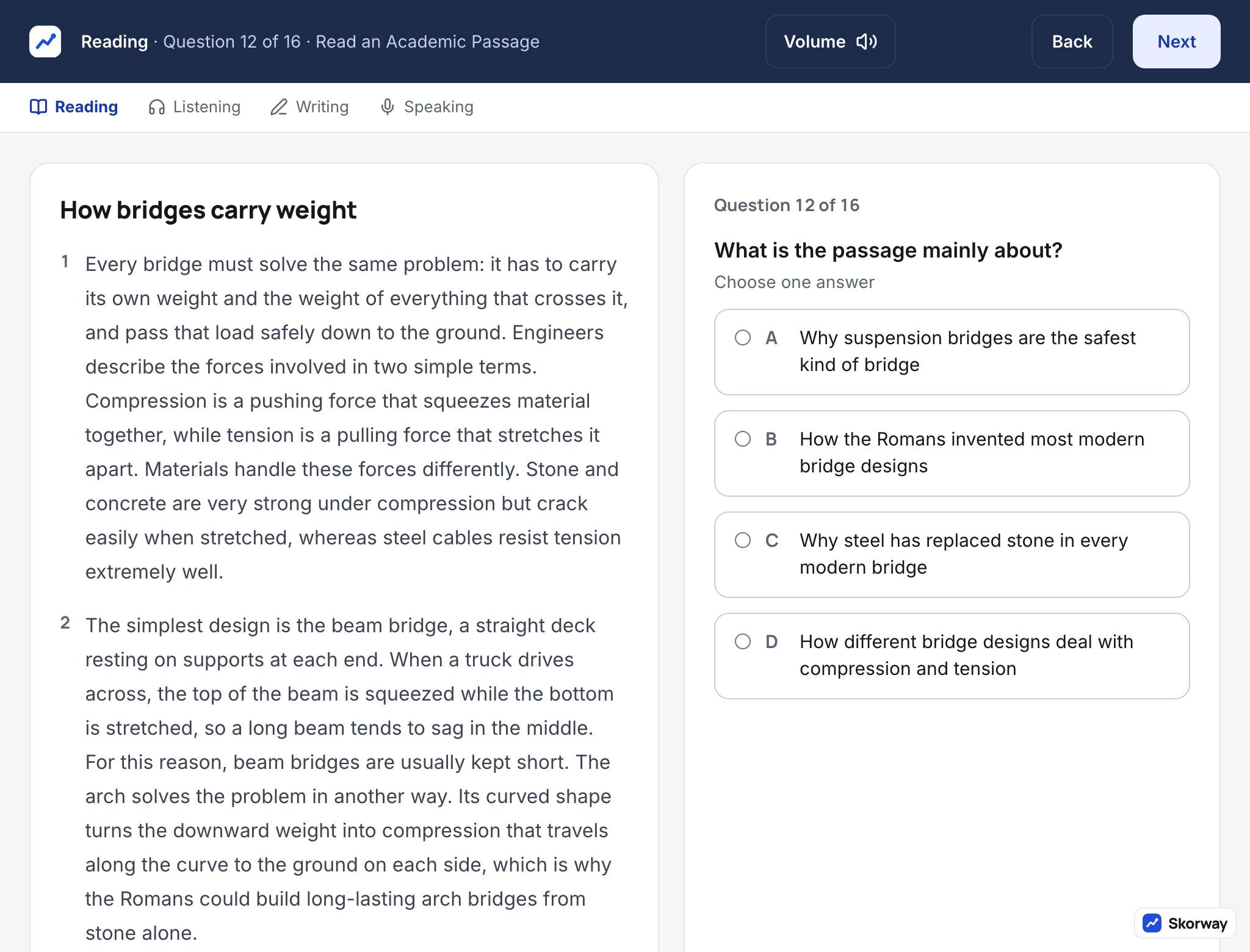
The question types
| Type | How the test asks it | What the key looks like |
|---|---|---|
| Vocabulary in context | The word "X" in the passage is closest in meaning to | The meaning in this sentence, not the most common meaning |
| Detail | According to the passage, why / how / what … | A paraphrase of one sentence |
| Negative detail | All of the following are mentioned EXCEPT | The one option the passage does not say |
| Inference | What does the passage suggest about X? | A small step from a stated fact |
| Author's purpose | Why does the author mention X? | "To give an example of …", "To show that …" |
| Paragraph relationship | What is the relationship between paragraphs 2 and 3? | Paragraph 3 solves, explains, contradicts or extends paragraph 2 |
Try it
How Railroads Changed the Clock
Until the nineteenth century, most towns set their clocks by the sun. Noon was the moment the sun stood highest in the sky, so it arrived a few minutes earlier in a town to the east than in a town to the west. For people who rarely traveled far, these small differences hardly mattered.
Railroads made them a serious problem. A train moving east or west passed through dozens of local times in a single journey, and each railroad company printed its timetables in a time of its own choosing. Passengers changing trains had to compare several clocks at one station, and a mistake about the time could put two trains on the same track.
The solution was to divide the land into broad zones that share a single time. British railways began using London time across their network in the 1840s, and in 1883 the railroads of the United States and Canada adopted four standard zones for the continent. Many towns resisted at first, but within a few decades standard time had become the law in many countries, and the sun no longer decided the hour.
1The word "resisted" in the passage is closest in meaning to
2According to the passage, why did noon arrive at different times in different towns?
3All of the following are mentioned as problems caused by local time EXCEPT
4Why does the author mention British railways in the 1840s?
5What does the passage suggest about people who rarely traveled far before the railroads?
What each question was doing:
- Question 1 offers "welcomed", the opposite, as a distractor. Vocabulary distractors are often opposites or words that fit the topic.
- Question 2 puts a railroad option first, because railroads are the subject of the passage; but the question is about noon before railroads, and the answer is in paragraph 1.
- Question 3 has three options taken from paragraph 2 and one that sounds like a railroad problem but is never mentioned.
- Question 4 is about function: the 1840s example is there to show the solution existed before 1883, not to compare countries.
- Question 5 is an inference: "these small differences hardly mattered" becomes "they did not need a single shared time". The wrong options are either unsupported or the wrong period.
The traps
- The right fact, the wrong question. A true statement from another paragraph. Check that the option answers what was asked.
- Overstatement. Options with "only", "always", "mainly" or "all" turn a fair inference into a wrong one.
- Reversed cause and effect. The passage says A led to B; the option says B led to A.
- True in the world, absent from the text. An option you know to be true is still wrong if the passage does not say it.
- The common meaning of a word. Vocabulary questions test the meaning in this sentence. Put each option into the sentence and read it.
How it is scored
Each question is 1 point, marked automatically. Reading's first part has one passage with 5 scored questions. The harder second part has one more; the easier second part has none. So you answer 5 or 10 scored passage questions, depending on your route. It is also the hardest task in the first part, and the first part decides which second part you get. The Reading guide has the whole section, and the guide to adaptive Reading explains the routing.
How to practise it
- Read the whole passage once before the questions. At 200 words it takes about a minute, and it makes every question faster.
- Name each paragraph's job in three words as you read: "problem", "evidence", "solution". Relationship and purpose questions become easy.
- For EXCEPT questions, tick off three options in the text. The one you cannot find is the key.
- Practise with short expository texts from encyclopedias or science magazines: read one, cover it, and write one sentence for what each paragraph did.
See your Reading band before test day
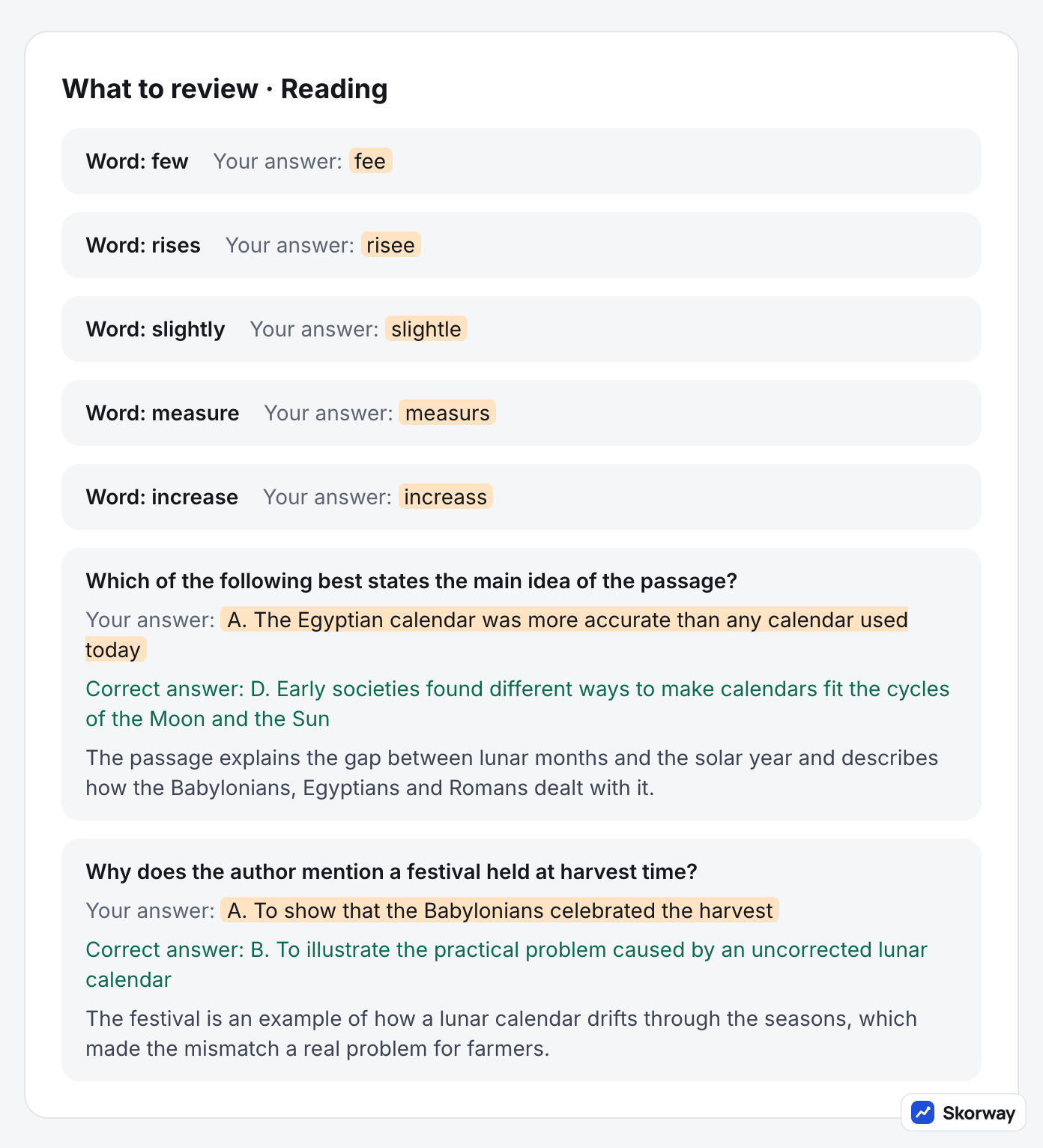
The academic passage is where Reading's first part is won or lost, and a band from Reading alone tells you little about which questions cost you the points. Skorway's free mock is the full 2026 test, with the academic passage in Reading's first part and, if you do well enough there, a second passage in the harder second part, on the real module clock. When the mock is done you have a band for every section, the part 2 you were routed to, every wrong answer next to the right one with the reason, and the three task types that cost you the most. The Reading practice sets have more passages, and the first two sets of every task type are free. No credit card.
How long is the academic passage on the TOEFL 2026?
About 200 words, usually between 170 and 230, in three paragraphs, with a title.
How many academic passages are in TOEFL Reading?
One in the first part for everyone. A second appears only in the harder second part; the easier second part has none.
Do I need background knowledge for Read an Academic Passage?
No. The passages are written so that someone who has never studied the subject can answer every question from the text alone.
Correct for the TOEFL iBT as it runs on 6 November 2026. TOEFL® is a registered trademark of ETS. Skorway is not endorsed or approved by ETS.