TOEFL speaking sample answers: one interview and three repeats at bands 4, 5 and 6
Sample TOEFL iBT Speaking answers for 2026: a four-question Take an Interview at band 4, 5 and 6, as transcripts with their 0 to 5 points, and what a band 4, 5 and 6 Listen and Repeat sounds like.
Updated November 13, 2026 · 14 min read
The short answer
The 2026 TOEFL® iBT Speaking section has two tasks, Listen and Repeat (seven sentences) and Take an Interview (four questions), and every answer gets 0 to 5 points. Below is one original interview with each question answered at band 4, band 5 and band 6, as transcripts, with the points each earns and what would lift it a band. Then come three Listen and Repeat sentences and what a band 4, 5 and 6 speaker typically says back.
How points become a Speaking band
Each of the eleven answers gets 0 to 5 points, so the raw Speaking score runs from 0 to 55. That total becomes your Speaking band from 1 to 6; there is no published table that turns one answer's points into a band.
On the old 0 to 30 Speaking scale, band 6 is 28 to 30, band 5 is 25 to 26, and band 4 is 20 to 22. Our working rule follows from that, and it is how the answers here are labeled:
| Band | CEFR | Typical points per answer |
|---|---|---|
| 6 | C2 | 5s, perhaps one 4 |
| 5 | C1 | Mostly 4s, some 5s |
| 4 | B2 | 3s and 4s |
The same speaker does not earn the same points on every question: the first is easy for almost everyone, and the last separates the bands.
What the interview points mean
Each interview answer is scored on four things, described in full on a single page:
| Points | Development | Pace | Intelligibility | Language |
|---|---|---|---|---|
| 5 | On topic and well elaborated | A good conversational pace, natural pauses | Easy to understand; rhythm and intonation carry meaning | A range of accurate grammar and vocabulary for precise meanings |
| 4 | On topic and elaborated, though it may lack linking between sentences | Generally good, some pausing that slightly affects flow | Occasional words take minor effort | Adequate for general meanings most of the time |
| 3 | Generally on topic, limited elaboration | Choppy, with frequent or long pauses and frequent fillers | Sometimes affected by word stress or pronunciation | A limited range that restricts precision |
A transcript shows development and language but not pace or pronunciation, so the transcripts below mark fillers (um, uh) and long pauses (…) where they happen.
The interview
These questions are original, written for this guide. Skorway's mock gives 45 seconds for each answer, and the answers below are written for that. The exact time on the test is not published.
You have volunteered for a research study about how people travel to work and school. You will have a short online interview with a researcher.
Question 1: how you travel
Thank you for joining us. Today I'd like to ask about how people get to work and school. First, how do you usually get to your classes or your job, and why do you travel that way?
Band 4 (4 points)
Um, I usually take the bus to my university. It's about thirty minutes. I take the bus because it's cheap, and, uh, I don't have a car. Also parking near the campus is very expensive… so bus is better for me. Sometimes when it rains the bus is late, but usually it's OK. I can listen music in the bus.
About 60 words. It answers, gives two reasons and a detail, so it is elaborated. The sentences are short and joined mostly with and and also, which is the "may lack linking" line of a 4. Small errors (bus is better, listen music, in the bus) do not block the meaning. To move up: fix the three errors, and join the ideas: "I don't have a car, and even if I did, parking near campus costs a fortune."
Band 5 (5 points)
Most days I take the bus, which stops right outside my building. It takes about thirty minutes, and I use that time to review my notes or listen to podcasts. I'd love to cycle, actually, but there's no bike lane on the main road, and it feels dangerous in the morning traffic. So the bus is a compromise: it's cheap, it's reliable most of the time, and I arrive at class without feeling stressed. On Fridays I sometimes walk home instead, because it's the only day I'm not in a hurry.
About 90 words. The answer comes first, then the reason becomes a choice (the bus against the bike), which is development, not a list. On an easy question, a band 5 speaker often earns the full 5.
Band 6 (5 points)
I take the train, mostly because it's the one part of my day nobody can interrupt. It's a forty-minute ride, and I've gotten into the habit of reading on it. I've finished more novels this year than in the three years before. Driving would be faster, but parking near campus costs more than my phone bill, and I'd lose that reading time. It's also the only hour of the day when my phone stays in my bag. So even when the train is crowded, I wouldn't swap it.
About 90 words, and the same 5. The difference from band 5 is precision: nobody can interrupt, gotten into the habit, costs more than my phone bill. The first question rarely separates band 5 from band 6. The next three do.
Question 2: a choice
I see. Would you rather live close to school or work in a small apartment, or farther away in a bigger one? Why?
Band 4 (3 points)
Uh, I would rather live… close to school in a small apartment. Because, um, it's close. I don't need to… to take the bus every day, so I save time. Small apartment is OK for me, I am student, I don't have many things. Um… yes. Close is better.
About 50 words. It chooses and gives one reason, but "because it's close" restates the choice, and the only development is "I save time". The answer is built from the question's own words (would rather live, close, small apartment), the fillers and the restart (to… to) make the pace choppy, and it ends early with "Um… yes." To move up: say what you would do with the time you save, give one example, and keep talking until the clock is nearly out.
Band 5 (4 points)
I'd choose the small apartment close to school. The main reason is time. If I lived far away, I'd spend, um… maybe two hours a day on the bus, and that's time I could use for studying or sleeping. Also, when you live close, it's easier to join things after class, like clubs or study groups. A bigger place would be nice, but honestly, I'm only at home to sleep most days, so space isn't so important for me right now.
About 80 words. The content would earn a 5: a choice, two reasons, and the other option dismissed with a reason. Two things hold it at 4. There is a long pause in the middle of a sentence, which affects flow, and the second reason is introduced with a plain Also and stays general (join things). To move up: pause between ideas, not inside them, and make the second reason specific.
Band 6 (5 points)
The small apartment, without much hesitation. A long commute costs more than time. It eats into the parts of the day that make student life worth it: staying late at the library, joining a study group, going out for dinner after a seminar. In my first year I lived an hour from campus, and I'd leave the moment classes ended to catch my train. I barely knew anyone by December. Space matters less at this stage. I can live with a small kitchen; I can't get those evenings back.
About 90 words. It answers in four words, then gives a reason with three concrete examples, then a short story that proves it. The last two sentences contrast (I can live with… I can't get… back), which is the kind of rhythm that carries meaning when spoken. Nothing is general.
Question 3: one or two ways
Interesting. What are one or two ways employers or schools could make the daily trip easier for people?
Band 4 (4 points)
Um, I think companies can give money for the bus ticket, because a ticket is expensive for young people. And also schools can start later. In the morning the traffic is very bad, very bad. So if classes start late, uh, the students are not in the traffic, and they arrive more relaxed. I think these are two good ways.
About 60 words. Two ideas, each with a simple reason, so it is on topic and elaborated: a 4. The repetition (very bad, very bad), And also, and the closing line that only restates the question keep it from a 5. To move up: cut the closing line and spend those seconds on an example for one of the ideas.
Band 5 (4 points)
I think the first way is flexible hours. If employees could start at seven or ten instead of everyone at nine, the buses and roads would be less crowded, and people would be less stressed when they arrive. The second way is for companies to pay part of a monthly train pass. My sister's company does this, and many of her coworkers stopped driving because of it. She says the parking lot is half empty now. Both ideas are not very expensive for the employer.
About 80 words. Two ideas, a reason for the first and a real example for the second. It stays at 4 for language: the first way is… the second way is sounds like a template, and the last sentence has an error of form (Both ideas are not should be Neither idea is). To move up: introduce each idea naturally ("The cheapest change would be…"), and fix the last sentence.
Band 6 (5 points)
The cheapest change is to stagger start times. If half the staff started at eight and half at ten, the morning rush would be split in two, and nobody would spend twenty minutes looking for a parking space. The second is to pay for transit passes. Right now a lot of employers give free parking, which quietly rewards driving. Offering the same value as a train pass would let people choose, and my guess is that many of them would leave the car at home.
About 85 words. Each idea comes with what it would change, and the second with a reason that is not obvious: free parking "quietly rewards driving". Stagger, the morning rush, my guess is that are exact and natural. It has a structure without announcing it.
Question 4: agree or disagree
Lastly, some people believe that if more people worked and studied from home, cities would be better places to live. Do you agree or disagree? Why?
Band 4 (3 points)
I agree. Because if people work from home, uh, there is less traffic and less pollution. The city is more clean. Also people have more time for family. Um… but some people like to go to office, they want to see colleague. So… I think it is good and bad. But I agree, um, cities will be better.
About 60 words. Three reasons are named but none is explained. The position wobbles (I agree… it is good and bad… But I agree), the last sentence repeats the question, and the errors (more clean, go to office, see colleague) add up. This is the question where band 4 speakers most often drop to a 3. To move up: pick one reason and explain it with an example. If you see both sides, say so in the first sentence ("I agree, with one condition") instead of changing your mind at the end.
Band 5 (4 points)
I mostly agree. When fewer people commute, there's less traffic and cleaner air, and you notice that on public holidays, when the roads are almost empty. But I think there's a downside for city centers. Cafés, small shops and restaurants depend on office workers at lunchtime, and if those workers stay home, some of these business will close. So my view is that working from home is good for the environment, but cities need to find new ways to keep their centers alive.
About 85 words. A clear position, a reason with an example, and a real downside. It is a 4 because the language is adequate but general: find new ways to keep their centers alive is general, and these business is missing its plural. To move up: fix the plural, and end with what cities should actually do.
Band 6 (5 points)
I agree, with one condition. Fewer commuters means quieter streets and cleaner air, which you notice on any public holiday. And people who aren't spending an hour on a train have more time for their own neighborhoods, so parks and shops near where people live could actually do better. The risk is to downtown areas built around office workers: if nobody comes in, the lunch places close and the center empties out. So yes, cities would be better places to live, but only if they're willing to turn some of those offices into homes.
About 95 words. The condition is in the first sentence, so the turn later on sounds planned. Each point has a consequence, and the last sentence answers the question again with a concrete proposal. For another full interview annotated pause by pause, see our band 5 interview answers, and for the four question types and how to shape each, our Take an Interview guide.
Listen and Repeat: what bands 4, 5 and 6 sound like
In Listen and Repeat you hear a sentence once and say it back word for word. A 5 is an exact, fully intelligible repeat. A 4 keeps the meaning with minor changes: a function word or two missing or changed, a related word in place of a content word, a tense or plural ending missing, or two words swapped. A 3 is a full sentence with most of the content words, but with several function words changed or missing, so the meaning is no longer accurate.
These three sentences come from one tour of a chemistry lab, as on the test: the scenario is that you are learning to help new students there. They are original, and they grow in length the way the seven test sentences do.
Sentence 1 (6 words): Lab coats hang behind the door.
| Speaker | What they say | Points |
|---|---|---|
| Band 6 | Lab coats hang behind the door. | 5 |
| Band 5 | Lab coats hang behind the door. | 5 |
| Band 4 | Lab coat hang behind the door. | 4: a plural ending is missing |
On short sentences, the bands sound almost the same. Where a band 4 speaker loses a point, it is usually an ending, like the -s of coats.
Sentence 2 (11 words): Gloves that have touched any chemical go in the yellow bin.
| Speaker | What they say | Points |
|---|---|---|
| Band 6 | Gloves that have touched any chemical go in the yellow bin. | 5 |
| Band 5 | Gloves that touched any chemical go in the yellow bin. | 4: have dropped, so the tense changes |
| Band 4 | The gloves that touch chemicals go to the yellow bin. | 3: several function words and endings changed |
The band 5 speaker kept every content word in order and lost one small word. The band 4 speaker kept the meaning roughly, but the was added, have touched became touch, any chemical became chemicals, and in became to. One change of that kind is a 4. Several, in one sentence, make a 3.
Sentence 3 (14 words): If a chemical spills, tell the instructor before you try to clean it up.
| Speaker | What they say | Points |
|---|---|---|
| Band 6 | If a chemical spills, tell the instructor before you try to clean it up. | 5 |
| Band 5 | If a chemical spills, tell the instructor before you clean it up. | 4: try to is missing |
| Band 4 | If the chemical spills, tell the teacher before you clean it. | 3: teacher for instructor, and try to and up are missing |
On a long sentence, a missing content word is still a 4. The band 4 speaker made one change a 4 allows (a related word, teacher for instructor), but also changed a to the and dropped three words. Together they cost two points.
Across the seven sentences, our working rule is that a band 6 speaker repeats them all exactly; a band 5 speaker gets 5s on the short ones and 4s on the last two or three; and a band 4 speaker gets 4s and 5s at the start and 3s on the long ones. Most of the difference between bands sits in sentences 5 to 7. Our Listen and Repeat guide shows one sentence at every score from 0 to 5 and the method for holding a long sentence in three pieces.
How long should a TOEFL speaking answer be?
For the interview, use nearly the whole answer time. In Skorway's mock that is 45 seconds, about 80 to 110 words at a calm pace. Every band 5 and band 6 answer above falls in that range; the band 4 answers are 50 to 60 words. For Listen and Repeat, the answer is the sentence itself: start within a second and say it at the speaker's pace.
Do fillers like "um" lower the TOEFL speaking score?
A few do not. Frequent fillers and long pauses are part of what makes a 3: they make the pace choppy. Pausing between ideas is natural and expected at 5; pausing in the middle of a phrase, as in the band 5 answer to question 2, is what costs the point.
Can I use a template for TOEFL speaking answers?
Use a shape, not a script. "Answer first, a reason, an example, stop" fits any interview question. A memorized opening such as "There are several reasons for my opinion" uses up seconds and adds nothing, and an answer made mostly of the question's own words sits at 2.
Hear your own answers scored
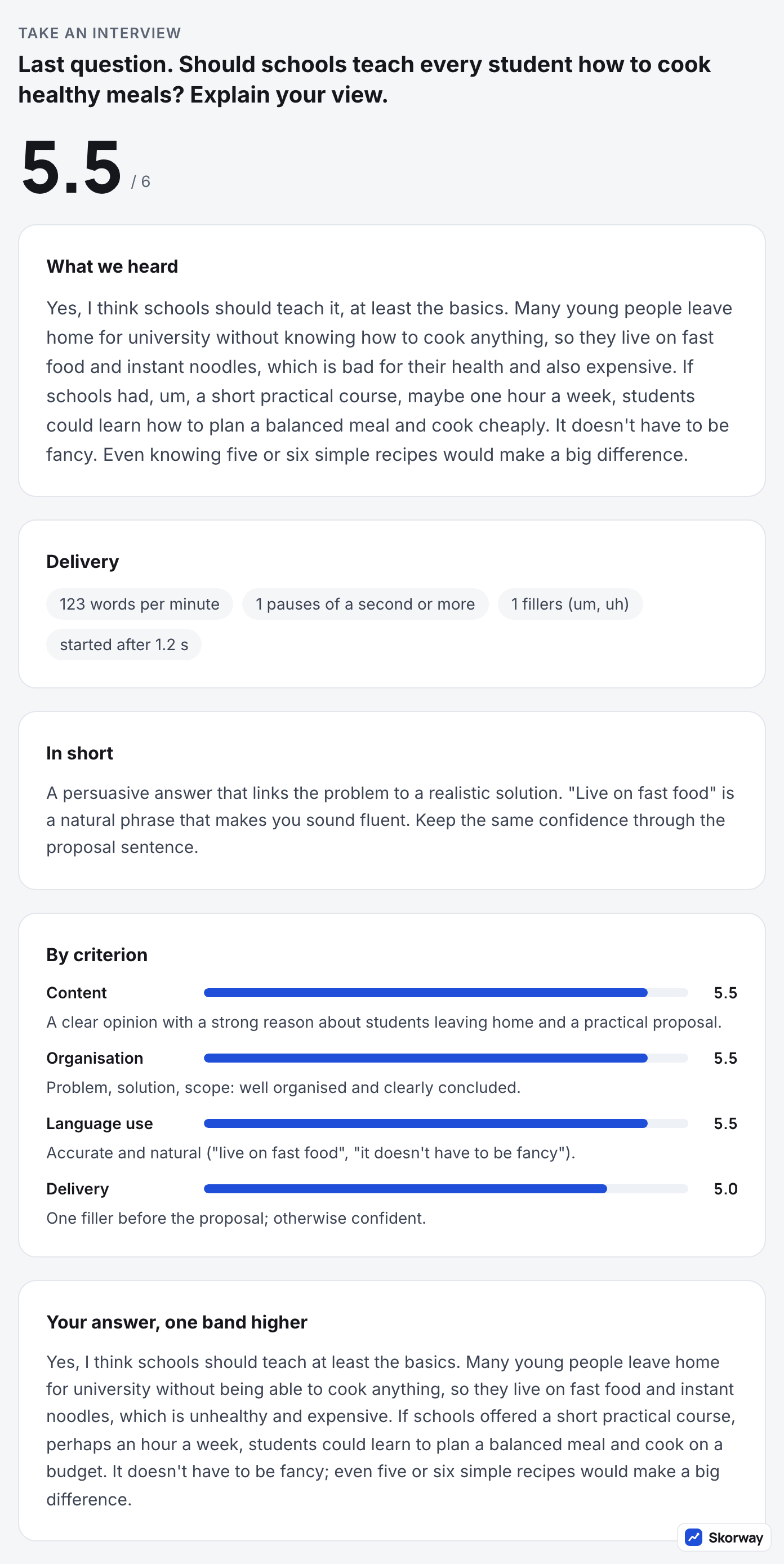
A transcript is easy to judge; your own voice, a second after the question ends, is not. Record yourself answering the four questions above in 45 seconds each and compare your transcript with the three versions: did you answer first, explain a reason, and keep going to the end? Then take a Skorway mock. It runs the full Speaking section as the test does, seven Listen and Repeat sentences and four interview questions, each prompt played once and recorded through your microphone on the clock. Every answer is scored twice, independently, and comes back with what we heard, your pace, pauses and fillers, a band for each criterion, and the interview answers rewritten one band higher. A few minutes after you finish you have a Speaking band on the 1 to 6 scale and a band for every other section. To hear how the prompts are played before any clock runs, start with the free Test Tour: the whole TOEFL test at your own pace.
Correct for the TOEFL iBT as it runs on November 13, 2026.