TOEFL Listen and Repeat: how it works, how it is scored, and 21 sentences to practice
TOEFL Listen and Repeat in 2026: seven sentences heard once, how each is scored 0 to 5, one sentence scored at every level, a method, and 21 practice sentences.
Updated November 7, 2026 · 8 min read
The short answer
Listen and Repeat is the first Speaking task on the 2026 TOEFL® iBT. A speaker shows you around a place, a library, a museum, a gym, and says seven sentences, one at a time. You hear each sentence once and say it back, word for word, into the microphone. The text is never shown. The sentences grow from about 5 words to about 14, and you get roughly 8 to 14 seconds to answer each. Every repeat is scored from 0 to 5: a 5 is an exact repetition, said clearly. The seven repeats are seven of the eleven Speaking scores.
What you see on screen
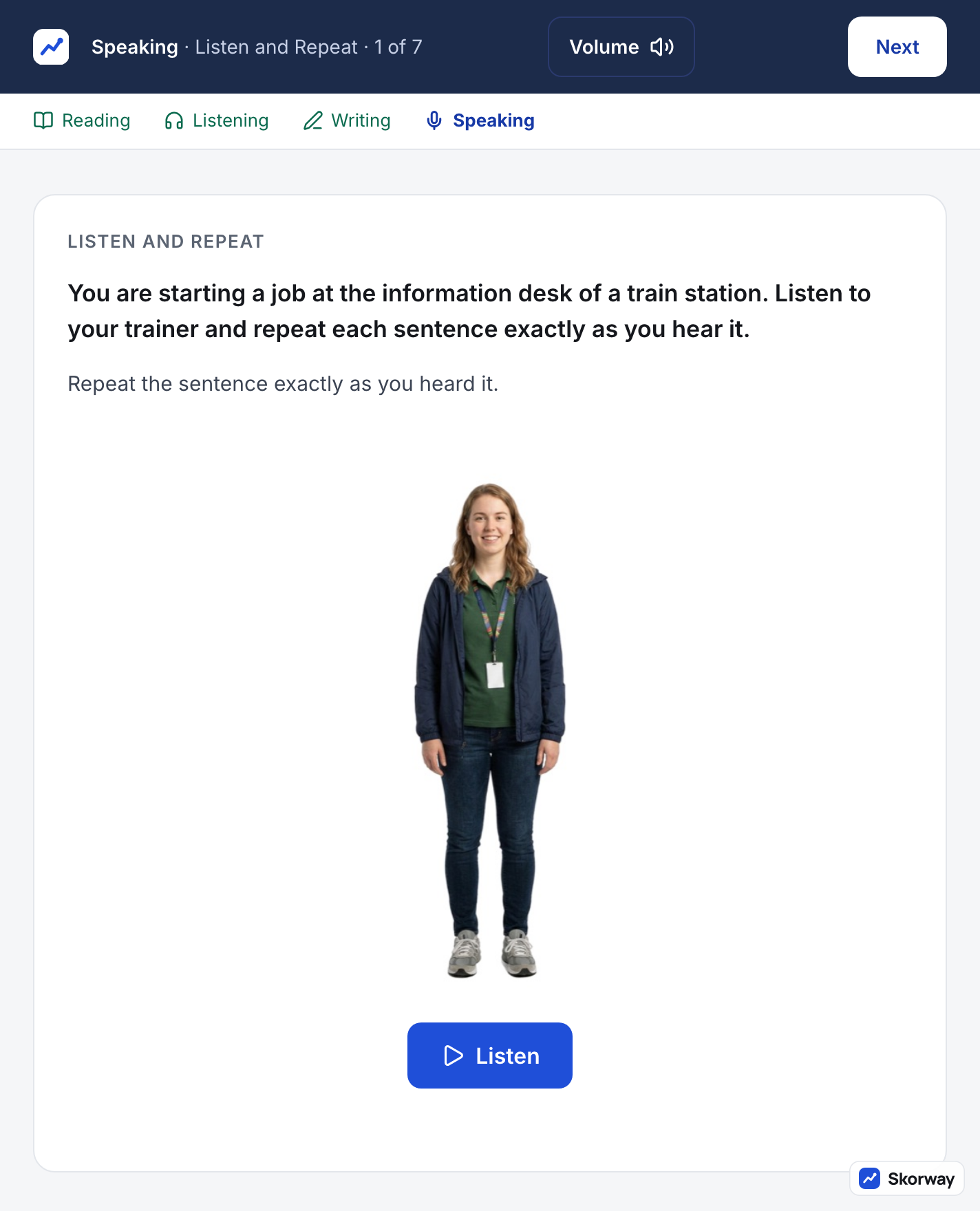
An instruction sets the scene: you are learning to guide new students or visitors around a place, and the speaker is training you. A picture of the place or the speaker stays on screen. Then the first sentence plays. When it ends, a clock appears and recording starts; when the clock runs out, the next sentence plays. There is no replay, no pause and no preparation time, and nothing is written down for you.
The seven sentences follow the tour. The first is a short welcome ("Welcome to the science library."), the middle ones say where things are and what the rules are, and the last two have two clauses or a long noun phrase ("If the book you need is checked out, ask us to hold it for you.").
How a repeat is scored
Each repeat gets one score from 0 to 5 on the Speaking scoring guide. The scorer checks three things: how much of the sentence you repeated correctly and in order, how intelligible each word was, and how fluently it came out. Here is one sentence at every level.
The sentence: Before you print anything, add money to your card at the machine by the stairs.
| Score | What was said | Why |
|---|---|---|
| 5 | Before you print anything, add money to your card at the machine by the stairs. | Exact, and every word clear. |
| 4 | Before you print anything, add money to your card at the machine near the stairs. | The meaning is kept; one word is replaced with a related one. One or two function words missing, a wrong tense ending, or two words swapped also land here. |
| 3 | Before you print, put money on the card by the stairs. | A full sentence with most of the content words, but "the machine" is gone and the meaning has changed. |
| 2 | Before you print anything, add money… um… by the stairs. | The first part, then a gap and the last few words. The meaning is in fragments. |
| 1 | Print… money… stairs. | A few words. |
| 0 | Nothing, or "Sorry, I didn't hear." | No usable repeat. |
Three things follow from the scale. You can correct yourself: the 4 level allows a self-correction as long as you finish the sentence. A small slip costs one point, not five, so keep going rather than stopping. And a fluent, clear 4 beats a halting, word-perfect attempt that runs out of time.
How to hold a long sentence
Nobody can hold fourteen separate words in their head. Most learners lose the sentence at about eight words, because they try to memorize sounds. The ones who score 4s and 5s on the long sentences listen for the meaning, in two or three pieces:
[Before you print anything] [add money to your card] [at the machine by the stairs]
Three ideas are easy to keep. Then say them back in that order, at the speaker's pace, and the small words ("to", "your", "at the") mostly come back on their own, because they are the words English needs to join those ideas.
Four habits make the method work:
- Start within a second. The sentence fades fast. Waiting to "get it right" in your head loses the end of it.
- Copy the speaker's rhythm. Short pauses between the pieces, none inside them. The scorer listens for fluency as well as words.
- Say the endings. Plural -s, past -ed and third-person -s are the function words that slip first, and each one is a point on the long sentences.
- Never stop for one lost word. Say the sentence through. A missing word is a 4; stopping is a 2.
If particular sounds cost you points (th, w and v, short and long vowels, final consonant clusters), our guide to the sounds that change the word has minimal pairs and a ten-minute daily drill.
Twenty-one sentences to practice with
Three tours of seven sentences, in the order and length of the test. Ask someone to read each sentence to you once at a natural pace, or record yourself and play each one once. Repeat straight away, then check against the text.
The science library
- Welcome to the science library.
- The quiet floor is upstairs.
- You can borrow books for three weeks.
- Group study rooms can be reserved online, up to a week ahead.
- Laptops are available at the front desk for two hours at a time.
- Please don't bring food past the entrance, but covered drinks are fine.
- If the book you need is checked out, ask us to hold it for you.
The art museum
- Thanks for volunteering with us today.
- The coat check is next to the main entrance.
- Photos are allowed, but please turn off the flash.
- The gallery on the second floor opens late on weekends.
- Visitors who need a wheelchair can borrow one at the information desk.
- Remind groups to stay behind the line in front of each painting.
- When the alarm sounds, lead visitors to the nearest exit and wait by the fountain.
The residence hall
- This is the main desk for the building.
- Mail is sorted every afternoon.
- Residents need their key card to get in at night.
- The laundry room is in the basement, and it's open all night.
- If a package is too big for the mailbox, we'll keep it here.
- Guests have to sign in at the desk and leave before midnight.
- Anyone who loses a key should tell us right away so we can change the lock.
Score yourself honestly with the table above. If your 6s and 7s are 2s and 3s, practice the piece method on the long sentences only for a week. That is where most of the points are.
Mistakes that cost points
- Paraphrasing. "Put money on your card" for "add money to your card" keeps the idea but costs points: the task asks for the speaker's words, not yours.
- Starting late. A three-second wait can turn a 5 into a 3 on a long sentence.
- Stopping halfway. One missed word is a small loss; abandoning the sentence is a large one.
- Rushing. Speaking faster than the speaker blurs words. Match the pace you heard.
- Swallowing endings. "Add money to your card at the machine by the stair" loses the -s and the point.
How is TOEFL Listen and Repeat scored?
Each of the seven repeats is scored from 0 to 5 on how much of the sentence was repeated correctly, how intelligible it was, and how fluent. A 5 is an exact, clear repetition; a 4 keeps the meaning with a small change. The seven scores join the four interview scores to make the Speaking band from 1 to 6.
Can I hear the sentence twice?
No. Each sentence plays once, and the clock starts when it ends.
Does my accent matter in Listen and Repeat?
Only as far as it affects intelligibility. An accent the listener can follow without effort costs nothing. A sound that turns one word into another, "ship" for "sheep", can cost a point.
How many sentences are in Listen and Repeat?
Seven, at the start of the Speaking section, before the four interview questions.
Hear how you score before test day
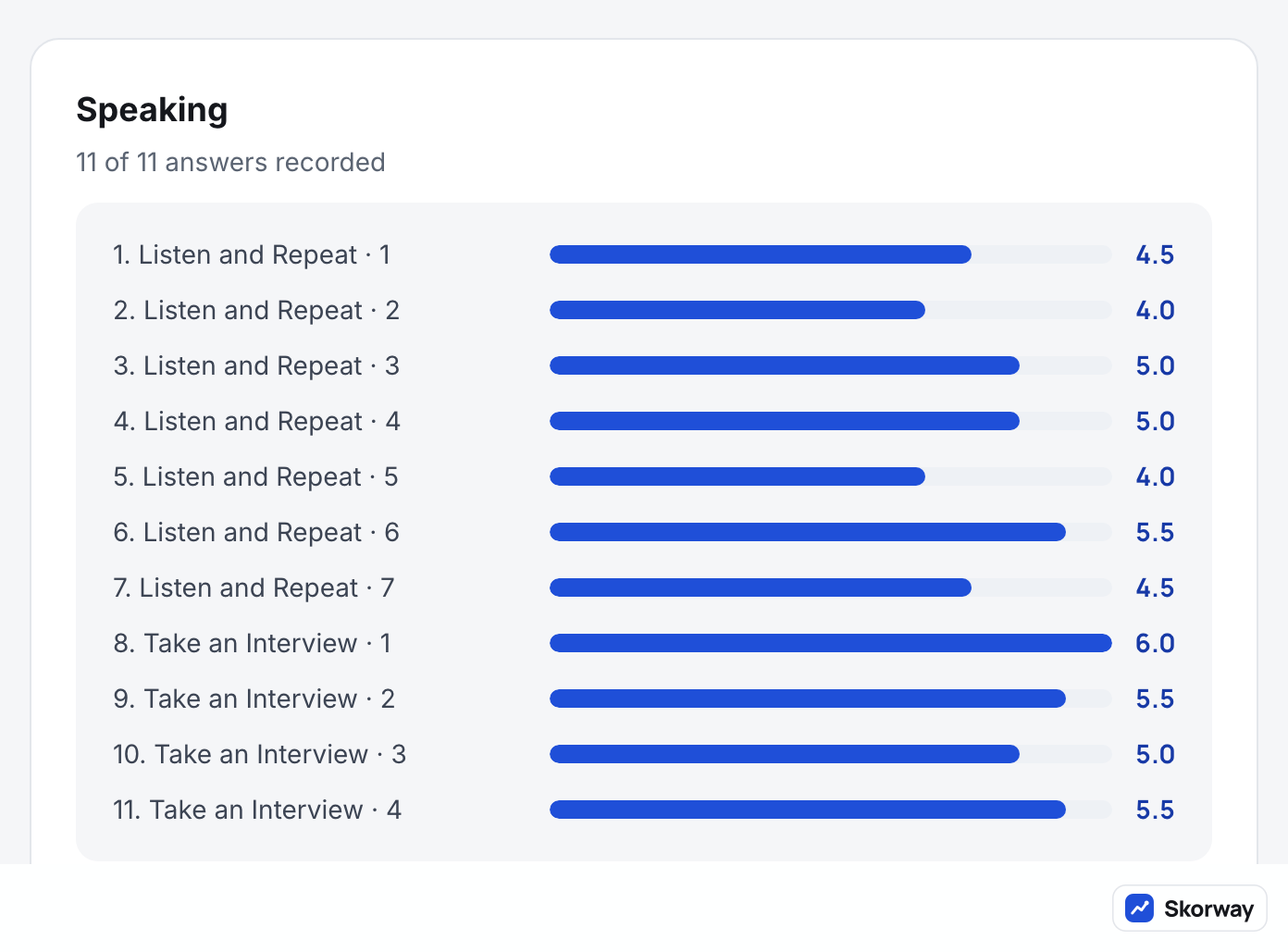
You can read a sentence back perfectly and still lose it when it is played once with a clock running. Skorway's free Speaking check plays one Listen and Repeat sentence and shows which words came through and your pace, in a minute, without an account. The free Test Tour has the full Speaking section, seven sentences and the four-question interview, at your own pace. A mock runs it timed as on test day, and every repeat is scored twice, independently, on the same three things as above, with a band for each sentence and the words that did not come through marked. A few minutes after you finish you have a Speaking band on the 1 to 6 scale and a band for every other section.
Correct for the TOEFL iBT as it runs on November 7, 2026.