TOEFL Take an Interview: the 2026 questions and how to answer each one
TOEFL Take an Interview in 2026: the four question types, an answer shape for each, a full model interview, how answers are scored, and 12 practice questions.
Updated November 7, 2026 · 9 min read
The short answer
Take an Interview is the second Speaking task on the 2026 TOEFL® iBT, after Listen and Repeat. A recorded interviewer asks you four questions on one topic, and you answer each one straight away, with no preparation time. The questions climb from your own life to a question about society. Each answer is scored from 0 to 5 on how well it answers and develops the question, how fluent and intelligible it is, and the range and accuracy of your language. The exact answer time is not published; Skorway's mock gives 45 seconds, which holds about 90 to 110 words at a natural pace.
What you see on screen
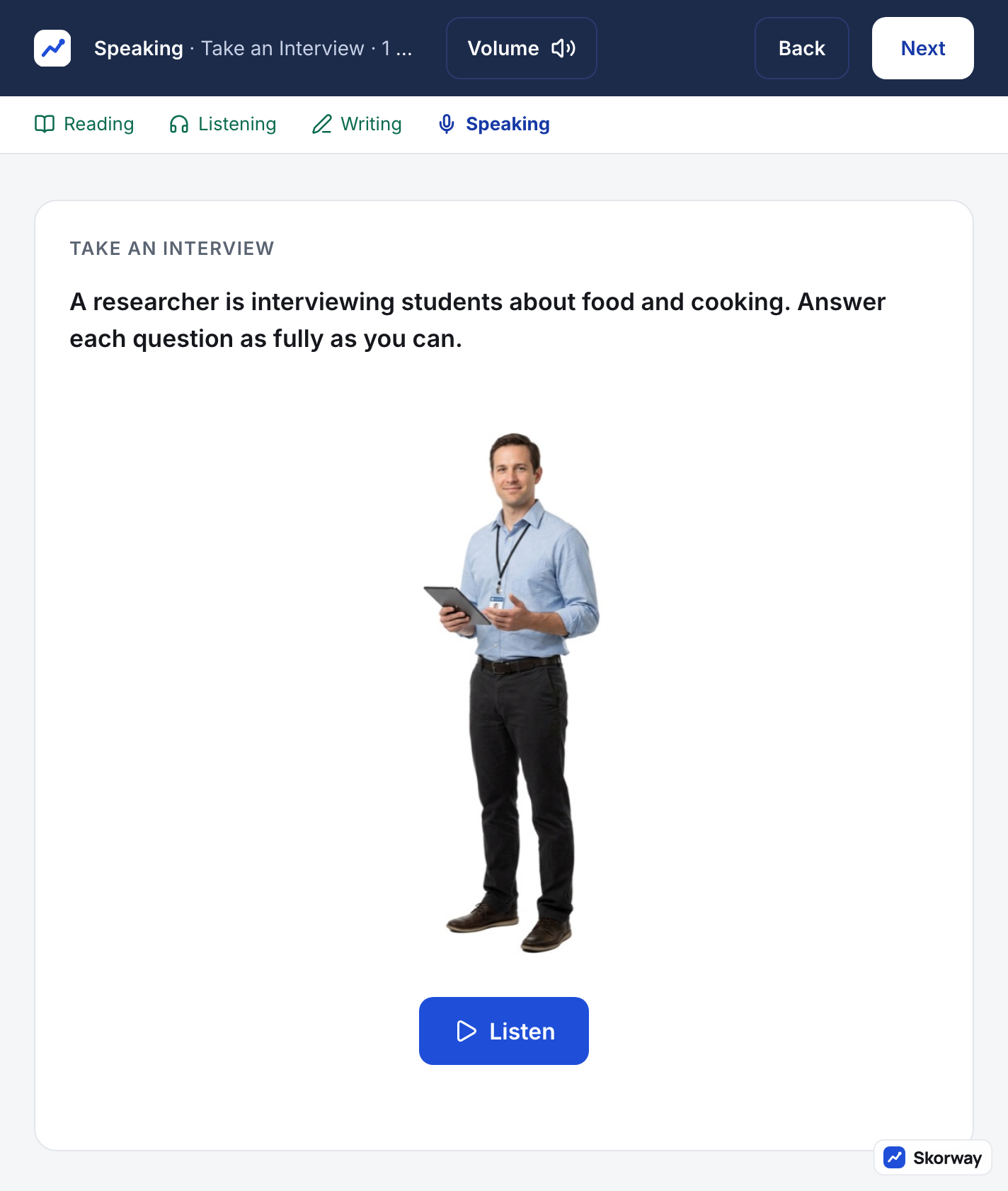
The instruction sets a situation: you have volunteered for a research study, or you are applying for a scholarship or a volunteer post, and a researcher will ask you a few questions online. The interviewer appears on screen, facing you, and speaks each question once. When the question ends, recording starts and the clock runs. There is no replay and no note-taking time, and the question is not written on screen.
Every turn is short, 15 to 40 words, and the interviewer reacts to your last answer with a word or two ("I see." "Interesting.") before the next question, as a real interviewer would.
The four questions, and the shape of an answer to each
The four questions follow the same order on every test. Knowing it is the closest thing this task has to preparation time.
Question 1: you, with a reason
"Thank you for joining us. Today I'd like to ask about how people spend their free time. First, what do you usually do on weekends, and why?"
Shape: answer in the first sentence, give the reason, add one concrete detail, stop. The first question is the easiest, and a full answer to it settles your nerves for the rest.
Question 2: a description or a choice
"If you could take a class in anything at all, what would you choose, and why?" or "Would you rather study alone or with a group?"
Shape: choose at once, give two reasons or one reason and an example. Do not weigh both sides: the question asks for a choice, and hesitating costs time and fluency.
Question 3: your view on a wider question
"What are one or two ways a city could encourage people to cycle more?"
Shape: two ideas, each with a sentence on why it would work. "One or two ways" is an invitation to give two: one idea with no development is a 3.
Question 4: a broad social question
"Some people say that working from home is better for families. Do you agree or disagree? Why?" or "What is one good effect and one bad effect of…?"
Shape: your position in the first sentence, a reason, an example or a consequence, and a closing sentence that answers the question again in different words. If you are asked for a good and a bad effect, give one of each, in that order.
A model interview
You have volunteered for a short research study about how people learn new skills as adults.
1. Thank you for joining us. First, is there a skill you have learned in the last year or two? Why did you decide to learn it?
Yes, last year I learned to swim properly. I could stay above water before, but I couldn't really swim a length. The reason was a trip with friends to a lake: everyone jumped in, and I stayed on the shore, which was a bit embarrassing. So when I got back, I signed up for evening lessons at a public pool, twice a week. After about three months I could swim a kilometer without stopping, and now I go every Saturday morning.
2. Interesting. Would you rather learn a new skill from a teacher or by yourself, with videos? Why?
I'd choose a teacher, mainly because a teacher sees mistakes I can't see myself. With swimming, for example, I watched a lot of videos first, but nobody told me that I was holding my head too high, and that was the whole problem. The second reason is motivation. When I've paid for a lesson and someone is waiting for me, I go, even when it's raining. With videos, I always find a reason to start next week.
3. What are one or two ways employers could help their staff learn new skills?
I think the simplest way is time. Many people want to learn, but after a full day of work they're too tired, so an employer could give one afternoon a month for training, during working hours. Another way is to let colleagues teach each other. In most offices someone is good at spreadsheets, someone else at presenting, and a short session once a week would cost the company almost nothing.
4. Finally, some people say that learning a skill is harder for adults than for children. Do you agree or disagree? Why?
I partly agree. Children seem to pick up things like languages and sports more naturally, and they're less afraid of looking silly, which matters a lot when you're a beginner. But adults have one big advantage: they choose what to learn and they know why they want it. When I started swimming, I had a clear goal, and that kept me going much longer than any school lesson did. So I'd say it's harder for adults to start, but not harder to succeed.
Each answer is 80 to 95 words: about 40 seconds at a calm pace. What they share:
- The answer comes first. "Yes, last year I learned to swim." "I'd choose a teacher." The listener never waits for the point.
- One story carries through. The swimming detail from question 1 returns as the example in questions 2 and 4. That is fair, and it saves you inventing a new example under pressure.
- Two ideas for "one or two ways". Each with its reason.
- The last answer turns. "I partly agree… But…" shows a view, not a recited position, and ends with a sentence that answers the question.
- The language is ordinary and correct. "Pick up", "kept me going", "too tired, so". Nothing memorized, nothing that sounds like a template.
The annotated band 5 answers go through another interview line by line, with notes on delivery and where a natural speaker pauses.
How an answer is scored
Each answer gets a score from 0 to 5 on the Speaking scoring guide, on four things:
- Development: whether it answers the question, with reasons, examples or details.
- Fluency: a good conversational pace, pauses at the ends of ideas rather than in the middle of them.
- Intelligibility: how easily the listener follows, with rhythm and intonation as much as individual sounds.
- Language use: the range and accuracy of grammar and vocabulary.
A 5 does all four well. A 4 is on topic and developed, perhaps without linking words, with a few words that take effort. A 3 is short or thin, choppy, with frequent fillers. A 2 barely connects to the question or mostly repeats its words. The step most learners need is from 3 to 4, and it is almost always development: a reason and an example in two or three sentences, instead of one sentence and silence.
The four answers join the seven Listen and Repeat scores to make your Speaking band from 1 to 6. With the same weight on each of the eleven items, the four interview answers are a little over a third of the section.
Twelve questions to practice with
Three interviews of four questions, in the test's order. Answer each one aloud for 45 seconds, with no pause to plan, and record yourself.
Shopping
- Thanks for taking part. We're asking people about how they shop. First, do you prefer shopping in stores or online, and why?
- Can you describe something you bought recently that you were really happy with?
- What are one or two ways stores could make shopping easier for older people?
- Lastly, some people think that online shopping is bad for city centers. Do you agree or disagree? Why?
Volunteering
- Thank you for joining us. Today I'd like to ask about volunteering. First, have you ever helped with a volunteer project? What did you do?
- Would you rather volunteer with a group of friends or with people you don't know? Why?
- What are one or two ways schools could encourage students to volunteer?
- Finally, some schools require students to do volunteer work before they graduate. What is one good effect and one bad effect of that?
Music
- Thanks for talking with me. I'm interested in the role music plays in people's lives. First, when do you usually listen to music, and why?
- If you could learn to play any instrument, which would you choose? Why?
- What are one or two ways a town could support local musicians?
- Last question. Some people say that music lessons should be required in every school. Do you agree or disagree? Why?
Mistakes that keep answers at 3
- Stopping at 15 seconds. A one-sentence answer cannot be "well elaborated". Add the reason and the detail.
- Thinking aloud before answering. "Hmm, that's a good question, let me think…" spends five seconds and sounds like a filler, because it is one.
- Repeating the question back. "What do I usually do on weekends? On weekends, I usually…" The scorer counts the question's words as the question's, not yours.
- A memorized template. "There are several reasons for my opinion. First and foremost…" sounds recited, and it delays the point.
- One idea for "one or two ways". Give two.
- Running out mid-sentence. If the clock is close, finish the sentence you are in. A clean last sentence is better than a third reason cut off.
How long do you have to answer TOEFL interview questions?
The answer time is not published. Skorway's mock gives 45 seconds per question, and 45 seconds of speech at a calm pace is about 90 to 110 words.
Is there preparation time in Take an Interview?
No. Each question plays once, and recording starts when it ends. That is the biggest change from the old Speaking section, where every task had 15 to 30 seconds to prepare.
Is the TOEFL interviewer a real person?
No. The interviewer is a recorded video, and the questions are the same for everyone on a test form. Your answers are scored afterwards.
How many questions are in Take an Interview?
Four, on one topic, from a personal question to a social one.
Hear how you score before test day
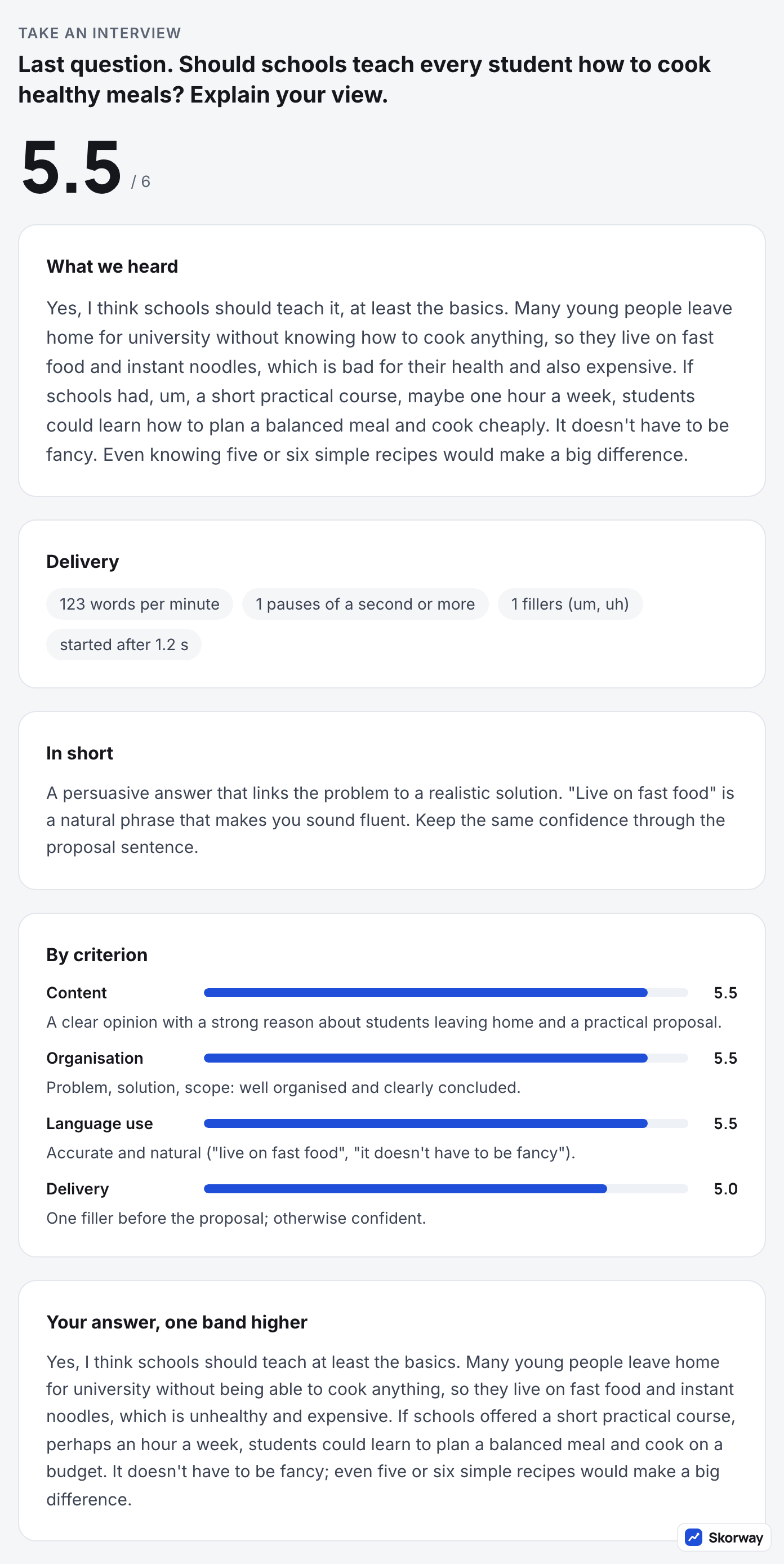
A model answer reads easily; saying ninety words with a clock running, a second after the question ends, is the actual skill. Skorway's free Test Tour shows you the whole Speaking section at your own pace, seven Listen and Repeat sentences and a four-question interview, each question played once. A mock runs it the way the test does, recorded through your microphone on the clock, and every answer is scored twice, independently, on the four things above, and comes back with what we heard, your pace, pauses and fillers, a band for each criterion, and your answer rewritten one band higher. A few minutes after you finish you have a Speaking band on the 1 to 6 scale and a band for every other section. The Speaking practice sets have more interviews, and the first two sets of every task type are free with an account.
Correct for the TOEFL iBT as it runs on November 7, 2026.