What is the TOEFL? The 2026 test explained for first-timers
What the TOEFL is, who asks for it, what is on the 2026 test, how it is scored from 1 to 6, what it costs, where you take it, and how to start preparing.
Updated November 7, 2026 · 7 min read
The short answer
The TOEFL® is an English test for people who want to study, and sometimes work or live, where English is the language of teaching. The name stands for Test of English as a Foreign Language, and it is run by ETS, a non-profit testing organization in the United States. When a university asks for "the TOEFL", it means the TOEFL iBT: a test of about 90 minutes on a computer, at a test center or at home, in four sections, Reading, Listening, Writing and Speaking. Since January 21, 2026 it is scored in bands from 1 to 6, and more than 13,500 institutions in over 160 countries accept it.
Who asks for a TOEFL score
- Universities and colleges, for undergraduate and graduate admission, when your first language is not English. This is what most people take it for.
- English-taught programs outside English-speaking countries, in Germany, the Netherlands, Korea and elsewhere.
- Scholarship offices and exchange programs.
- Some professional bodies and visa authorities. Their rules differ by country and change, so check the body that will receive your score before you book.
The requirement is set by whoever receives the score, not by the test. One program may ask for a 4.5 overall, another for a 5.5 with no section below 5. Our guide to what a good band is has published 2026 requirements from real universities.
What is on the test
Four sections, always in this order, with 12 task types between them:
| Section | Task types | Time |
|---|---|---|
| Reading | Complete the Words, Read in Daily Life, Read an Academic Passage | about 30 minutes |
| Listening | Listen and Choose a Response, Listen to a Conversation, Listen to an Announcement, Listen to an Academic Talk | about 29 minutes |
| Writing | Build a Sentence, Write an Email, Write for an Academic Discussion | about 23 minutes |
| Speaking | Listen and Repeat, Take an Interview | about 8 minutes |
That is 1 hour 23 minutes to 1 hour 29 minutes of timed work in an appointment of about two hours. The topics mix campus life and everyday situations (an email to a landlord, a notice in a library) with short academic texts and talks. No subject knowledge is needed: everything you have to know is in the passage or the recording.
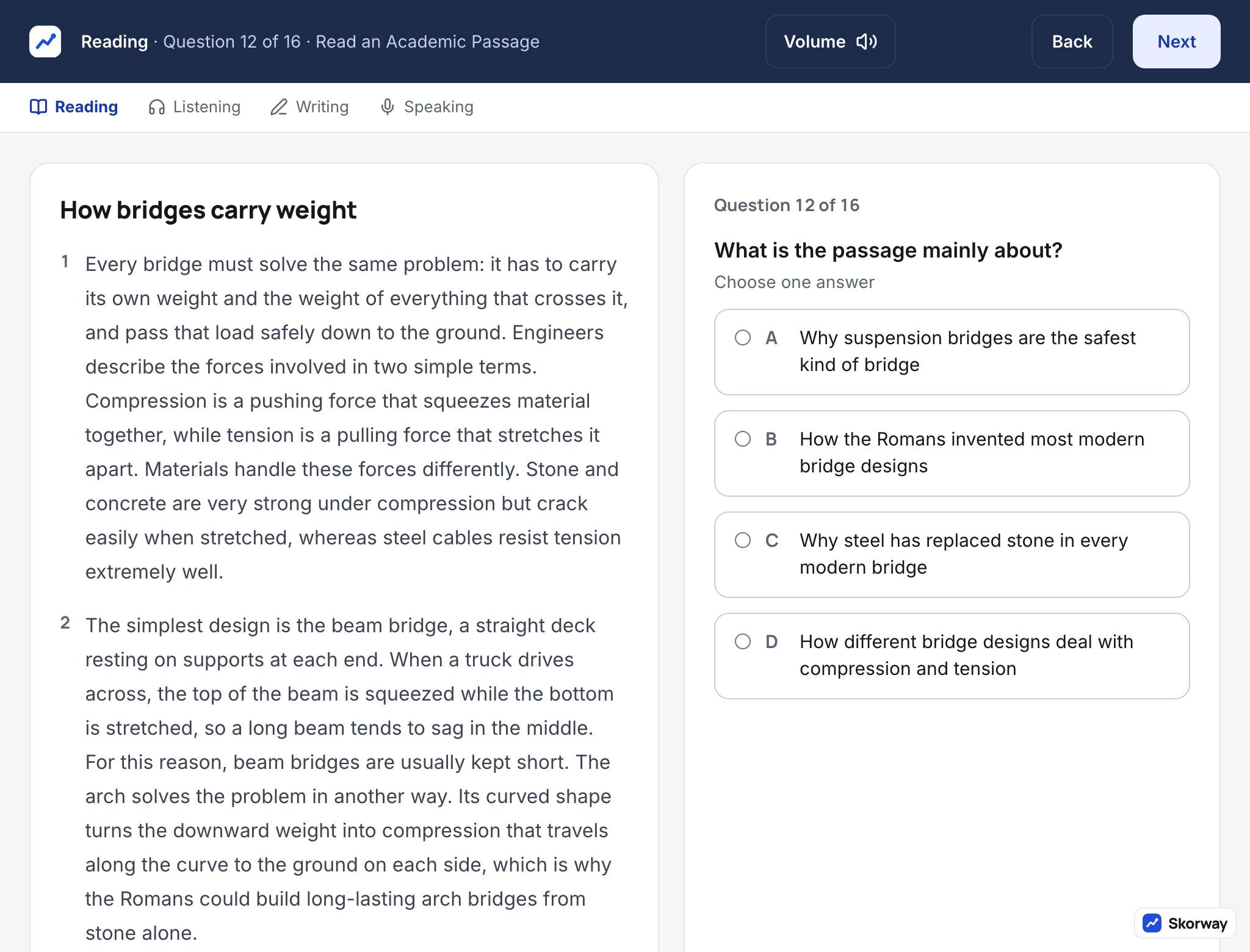
Two things surprise first-timers. Reading and Listening are adaptive: your first part decides whether the second part is easier or harder, and the score takes that into account. And everything is played or shown once: no replay in Listening, no preparation time in Speaking. Our guide to all 12 task types shows what each one asks you to do.
How it is scored
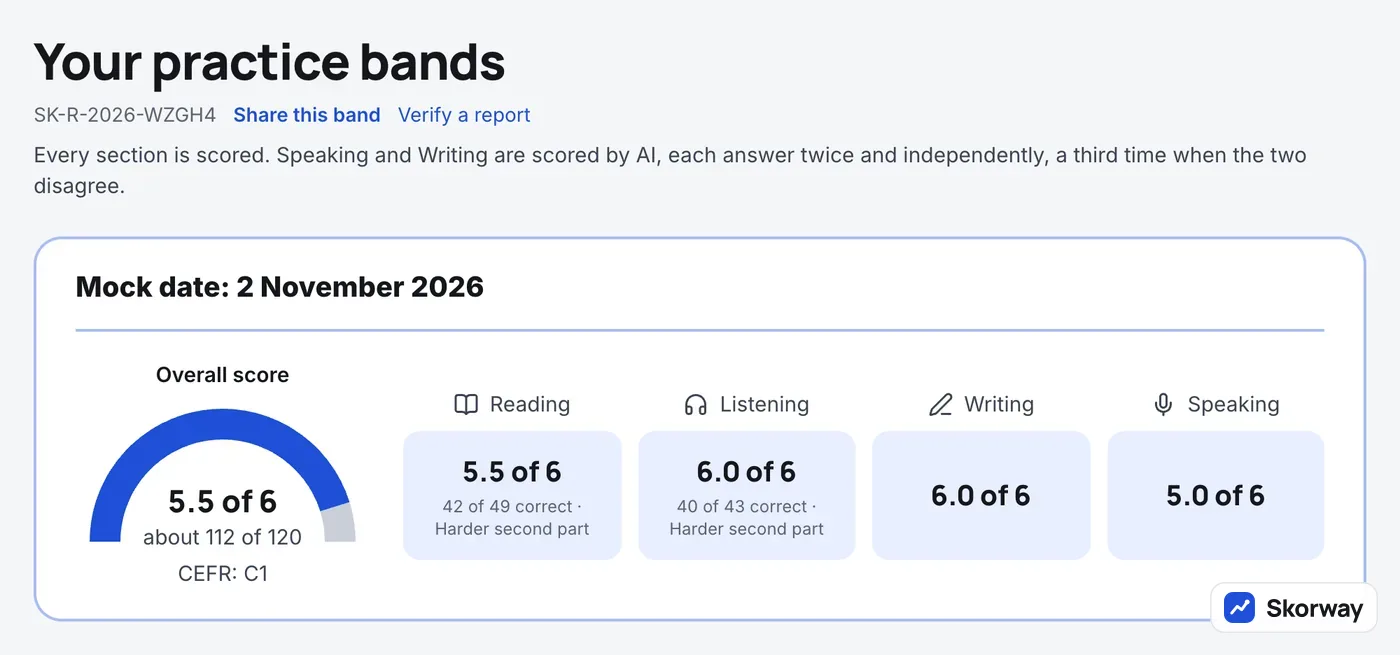
Each section gets a band from 1 to 6 in half steps, and the overall band is the average of the four, rounded to the nearest half. Each band is linked to a level of the Common European Framework (CEFR):
| Band | CEFR | Old 0–120 total |
|---|---|---|
| 6 | C2 | 114 to 120 |
| 5.5 | C1 | 107 to 113 |
| 5 | C1 | 95 to 106 |
| 4.5 | B2 | 86 to 94 |
| 4 | B2 | 72 to 85 |
| 3 | B1 | 44 to 57 |
Until January 2028 the score report also shows a comparable 0 to 120 total, for universities that have not yet moved to the new scale. There is no pass mark. Scores arrive in your ETS account about three days after the test and stay valid for two years. The band scale guide has the full table, and the score converter turns an old total into a band.
Where you take it, and what it costs
You take the TOEFL iBT at an authorized test center or at home with the Home Edition, which is the same test on your own computer with a live proctor watching through the camera. Both are accepted in the same places. You register in your ETS account; the fee is set by country and shown when you choose your location, for example ₹15,729 in India. Rescheduling costs US$69, and each score report beyond the four included costs US$29.
The registration guide covers deadlines and ID rules, and the Home Edition guide covers the equipment and the room check.
TOEFL iBT and the other TOEFL tests
ETS makes several tests with TOEFL in the name, and only one of them is the one universities mean. TOEFL Essentials is a shorter at-home test accepted in fewer places; TOEFL ITP is a paper or digital test that schools run for their own students; TOEFL Primary and TOEFL Junior are for children. If an application says "TOEFL" with nothing after it, it means the TOEFL iBT. Our guide to the TOEFL tests compared sets them side by side.
How to start preparing
- Find out the band you need, from each program's admissions page, including any section minimums.
- Find out the band you have, with one full timed test, before you study anything. The gap between the two decides how long you need.
- Learn the format. Most lost points on a first attempt come from the format, not the English: a clock you did not expect, a recording you cannot replay, a speaking answer with no time to plan.
- Practice the weakest section first. The overall band is an average, so lifting a 4 to a 5 in one section moves the total as much as anything else you can do.
The six-week study plan turns this into a week-by-week schedule.
What does TOEFL stand for?
Test of English as a Foreign Language. "iBT" stands for internet-based test, the computer version introduced in 2005, which took over from the older paper and computer-based tests.
Is the TOEFL iBT the same as the TOEFL?
Yes, in practice. The TOEFL iBT is the TOEFL test universities ask for. The other TOEFL tests (Essentials, ITP, Primary, Junior) have different names because they have different uses.
How long is the TOEFL?
About two hours for the whole appointment, of which 1 hour 23 minutes to 1 hour 29 minutes is timed work. Our timing guide has the minutes for every part.
Is the TOEFL hard?
It is not a test you pass or fail. It measures your level from beginner to near-native, and each university decides which level it accepts. For most applicants the question is whether they can reach a 4.5 or a 5, the B2 and C1 levels most programs ask for.
How long is a TOEFL score valid?
Two years from the test date.
Take the test once before you book it
The quickest way to understand the TOEFL is to sit it. Skorway's free Test Tour is the whole 2026 test at your own pace: all four sections in the real order, all twelve task types, spoken directions before each part and recordings that play once, with no clock and no account needed to start. When you want to know where you stand, a mock runs the same format on the real clocks: Reading and Listening route you to an easier or harder second part, and Speaking records you through your microphone. A few minutes after you finish you have a band from 1 to 6 for every section and overall, with the old 0 to 120 total and your CEFR level, and every Writing and Speaking answer comes back scored with what to fix. You know where you stand before you pay the registration fee.
Correct for the TOEFL iBT as it runs on November 7, 2026.