TOEFL iBT, ITP, Essentials, Junior: which TOEFL test do you need?
The TOEFL tests compared: iBT, Essentials, ITP, Primary and Junior. Length, sections, scores, where you take them, who accepts each, and which to book.
Updated November 7, 2026 · 6 min read
The short answer
If a university, a scholarship or an English-taught program asks for "the TOEFL", book the TOEFL iBT. It is the TOEFL test that more than 13,500 institutions in over 160 countries accept, and the only one whose scores you can send to any institution you choose. The other tests with TOEFL in the name have narrower jobs: TOEFL Essentials is a shorter at-home test that a smaller list of institutions accepts; TOEFL ITP is a test that schools and universities run for their own students, with scores for internal use; TOEFL Primary and TOEFL Junior are for children aged 8 and up and 11 and up.
The TOEFL tests side by side
| TOEFL iBT | TOEFL Essentials | TOEFL ITP | TOEFL Primary / Junior | |
|---|---|---|---|---|
| For | University admission, scholarships, some visas | Admission where it is listed as accepted | Placement and progress inside a school or university | Children and teenagers at school |
| Length | about 90 minutes of timed work, about 2 hours in all | about 1.5 hours | 115 minutes (Level 1) or 70 minutes (Level 2) | varies by test |
| Sections | Reading, Listening, Writing, Speaking | Listening, Reading, Writing, Speaking, and an unscored video statement | Listening, Structure and Written Expression, Reading; Speaking optional | Reading and Listening, with Speaking and other parts by test |
| Where | Test center or at home | At home | At the institution that runs it, on paper or digitally | At school or a local center |
| Scores | Bands 1 to 6 | 1 to 12 | 310 to 677 (Level 1), 200 to 500 (Level 2) | Scaled scores linked to CEFR |
| Who registers | You | You | The institution | The school |
TOEFL iBT: the one universities mean
The iBT is the full academic test: four sections and 12 task types, adaptive Reading and Listening, and two Speaking tasks recorded through a microphone. Since January 2026 it reports a band from 1 to 6 for each section and overall, each linked to a CEFR level from A1 to C2, with scores in your account about three days after the test, valid for two years. You choose the institutions that receive your scores, four of them included in the fee.
The Home Edition is the TOEFL iBT, not a separate test: the same content and scoring, taken on your own computer with a live proctor. It is accepted in the same places as a test-center score, though a few programs state a preference for the center. Our Home Edition guide covers the rules.
MyBest scores are not a test either: they are the best score for each section across your iBT tests in the last two years, shown on your report. Many universities accept them; check before you count on it.
TOEFL Essentials: shorter, at home, accepted in fewer places
TOEFL Essentials takes about 1.5 hours, at home, on the same platform and security as the Home Edition. It has the same four skills, but half of its content is general English rather than academic, and the whole test is multistage adaptive. It measures the full range from CEFR A1 to C2 with fewer items, and it ends with a five-minute personal video statement that is not scored. Sections are scored from 1 to 12.
The catch is acceptance. A growing number of universities take Essentials, but far fewer than the iBT, and many admissions pages that say "TOEFL" mean the iBT only. Book Essentials only if every institution on your list names it. The fee on the registration page was US$199 on November 7, 2026.
TOEFL ITP: run by your school, for your school
TOEFL ITP is a multiple-choice test that a school, university or language program buys and runs for its own students: for placement into English classes, to check progress at the end of a course, or as an entry requirement for its own programs. You do not register on your own; the institution does. It comes in two levels:
| Level 1, intermediate to advanced | Level 2, high beginner to intermediate | |
|---|---|---|
| Listening Comprehension | 50 questions, 35 minutes | 30 questions, 22 minutes |
| Structure and Written Expression | 40 questions, 25 minutes | 25 questions, 17 minutes |
| Reading | 50 questions, 55 minutes | 40 questions, 31 minutes |
| Total | 140 questions, 115 minutes, 310 to 677 | 95 questions, 70 minutes, 200 to 500 |
A 15-minute Speaking test can be added to the digital version, scored separately. There is no Writing section and no essay.
The format is the old paper TOEFL's, and the score report is for the institution's internal use: you cannot send an ITP score to another university the way you send an iBT score. If you want a score that any university will read, ETS points you to the iBT. ITP scores are valid for two years, at the institution that accepts them.
TOEFL Primary and TOEFL Junior
These are tests for school students. TOEFL Primary, for ages 8 and up, measures early reading, listening and speaking. TOEFL Junior, for ages 11 and up, is aimed at middle and lower secondary school students, with Listening, Language Form and Meaning, and Reading, and a Speaking test. Schools use them for placement and to track progress; some secondary schools with English-language programs ask for TOEFL Junior. Neither is used for university admission.
Which one should you book?
- You are applying to a university, a graduate program or a scholarship: the TOEFL iBT, at a center or at home.
- Every institution on your list names TOEFL Essentials as accepted: Essentials is shorter. If even one does not, the iBT covers them all.
- Your school or university told you to take the TOEFL ITP: take it there; it is their test. If you also plan to apply elsewhere, you will need the iBT for that.
- You are under 15 and a school asked for a TOEFL score: check whether it means TOEFL Junior.
Is the TOEFL iBT the same as the TOEFL?
Yes. When an application asks for a TOEFL score, it means the TOEFL iBT unless it names another test.
Is TOEFL ITP accepted by universities?
Only by the institutions that run it or say they accept it, usually for their own placement, exchange or pathway programs. It is not a replacement for the iBT, and its scores are not sent between universities.
Is TOEFL Essentials easier than TOEFL iBT?
It is shorter and half general English, and it reports a different scale, so the two are not directly comparable. What decides it is whether your university accepts it, and fewer do.
Is there still a paper TOEFL?
Not for university admission. The TOEFL iBT is taken on a computer, at a center or at home; the ITP and the tests for children can still be run on paper by the schools that use them.
Find your iBT band before you book
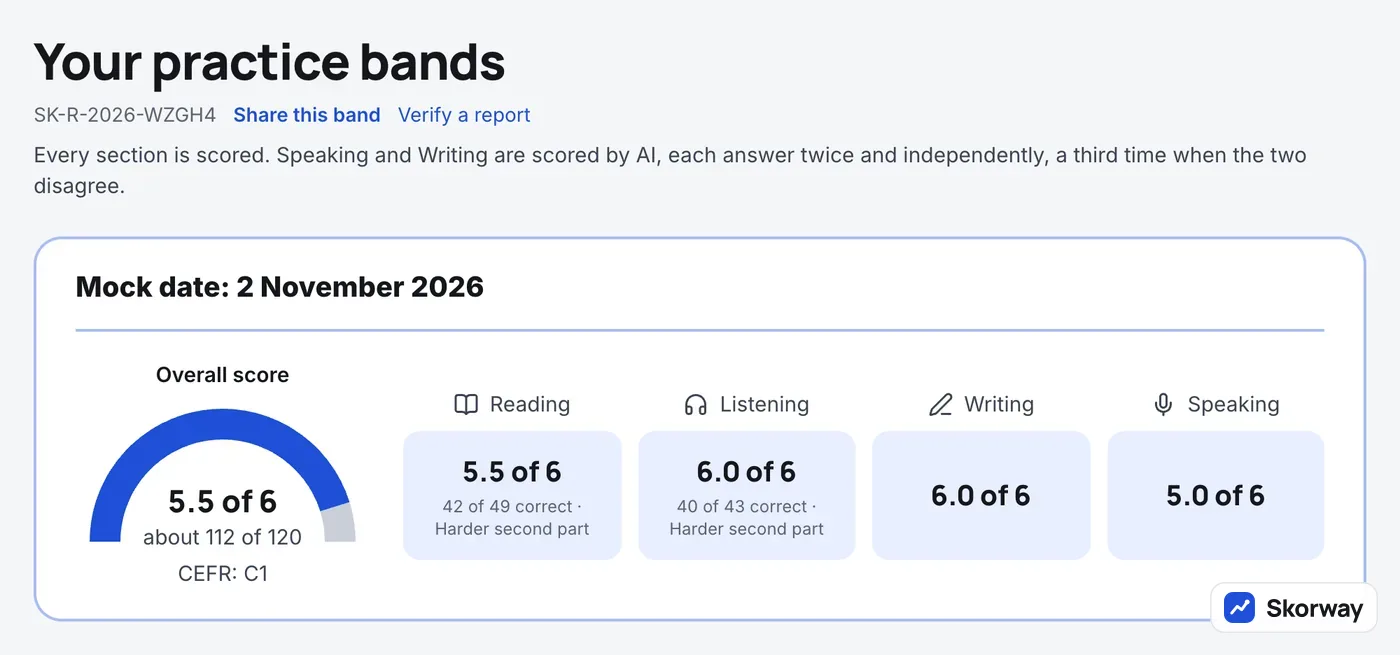
If the iBT is the test you need, the useful question is how far you are from the band your programs ask for. A Skorway mock is the full TOEFL iBT as it runs in 2026: all four sections and twelve task types on the real clocks, adaptive Reading and Listening, Speaking recorded through your microphone. A few minutes after you finish you have a band from 1 to 6 for every section and overall, the old 0 to 120 total and your CEFR level, and every Writing and Speaking answer comes back scored with what to fix. The guide to the TOEFL itself covers the rest of what a first-timer needs to know. To see the iBT itself first, the free Test Tour is the whole test at your own pace, with no clock and no account needed to start.
Correct for the TOEFL tests as they run on November 7, 2026.