TOEFL Read in Daily Life: the texts, the questions and the traps, with two samples
TOEFL Read in Daily Life in 2026: the emails, notices and text chains you read, the question types, two samples with answers, and the traps to avoid.
Updated 6 November 2026 · 7 min read
The short answer
Read in Daily Life is the second Reading task on the 2026 TOEFL® iBT. You read a short, real-world text of 15 to 150 words, such as an email, a chain of text messages, a notice, a menu or a schedule, and answer 2 questions about a short text or 3 about a longer one. The text stays on screen beside the questions. Each question is 1 point, marked automatically. You meet it in Reading's first part and, if you are routed to the easier second part, again there.
What the texts look like
The formats are the texts you read every day:
- an email, laid out as one, with To, From, Date and Subject lines;
- a chain of text messages, with names and times;
- a notice, sign or poster;
- a menu, a schedule or a receipt;
- an advertisement or a web page;
- a short news article or a social media post.
The settings are social and academic, from many countries. No text needs background knowledge: everything you need to answer is on the screen. The language can be informal, with short forms and the odd idiom, because that is how real messages are written.
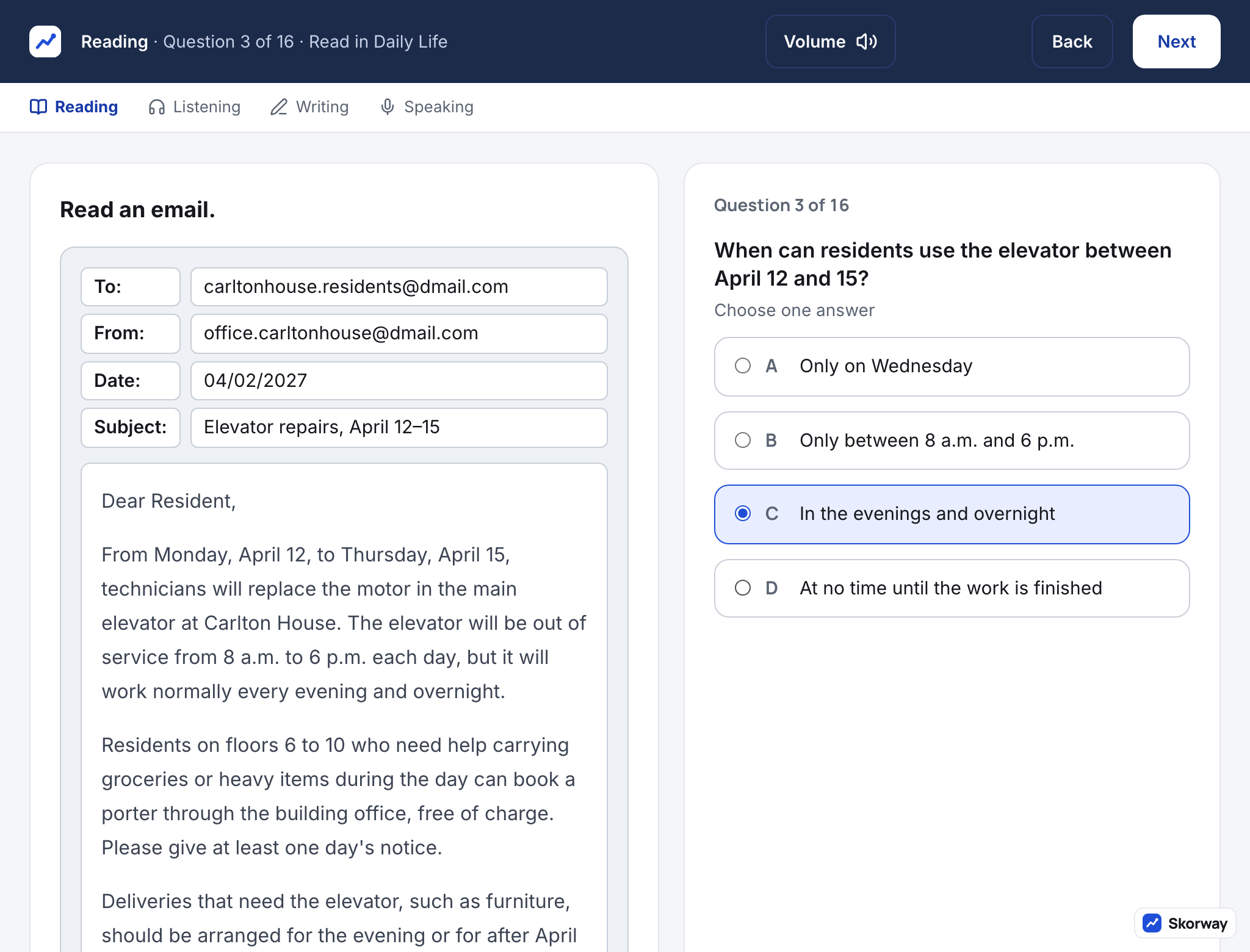
What the questions ask
Most questions are one of five kinds:
| Question | What it sounds like |
|---|---|
| Purpose | Why did Ms. Kim send the email? What is the main purpose of the notice? |
| Detail | When will the package arrive? What must volunteers bring? |
| Inference | What can be inferred about the meeting on Friday? |
| Meaning of a phrase | What does Ana mean when she writes "no worries"? |
| Next action | What will the writer most likely do next? |
Try it: a text message chain
Read a text message chain.
Jason (4:52 PM): hey, are we still on for the study group tonight?
Megan (4:55 PM): yes! but the library closes early today, 7 instead of 9
Jason (4:56 PM): ugh. want to move it to the café on Pine St?
Megan (4:58 PM): works for me. I'll text the others. 6:30?
Jason (4:59 PM): perfect. I'll grab a big table
Megan (5:00 PM): you're a lifesaver!
1Why does Jason suggest meeting at the café?
2What will Megan most likely do next?
The first question is the classic trap: three options use details from the chain (6:30, a big table, the others), but only one answers why. The second asks you to read "I'll text the others" as a plan, which is what next-action questions always want: the writer's own words about what they will do.
Try it: a notice
Read a notice.
Riverside Community Garden: Spring Planting Day
Saturday, April 18 · 9:00 a.m. to 1:00 p.m. · Garden entrance on Elm Avenue
- Seeds and tools: provided by the garden. Bring gloves and a water bottle if you have them.
- New plots: twelve are available this year. Sign up at the shed before 10:00 a.m.
- Workshop: a short class on composting starts at 11:00 a.m. in the greenhouse.
- Children: welcome with an adult. A painting table will be set up near the gate.
Free lunch for all volunteers who stay until noon.
1What is the main purpose of the notice?
2What must people do to get one of the new plots?
3What is indicated about lunch?
The purpose question has one tempting wrong answer: the composting class is on the notice, but it is one bullet among four, not the reason the notice exists. The third question is a paraphrase test: the key restates the last line in other words, while every wrong option borrows a detail from somewhere else on the notice.
The traps
- A real detail that answers a different question. The most common wrong option is a time, name or place from the text that is correct but beside the point. Find the line that answers the question asked.
- A part mistaken for the whole. In purpose questions, one bullet or one sentence is offered as the main purpose.
- The same words, the wrong meaning. An option that copies a phrase from the text is suspicious; the key usually paraphrases.
- Reading short forms literally. "np", "running late", "works for me" mean what they mean in a message, not word by word.
- Inference stretched too far. The key to an inference question is a small step from the text, not a guess about what probably happened.
How it is scored
Each question is 1 point, marked automatically by the answer key. Reading's first part has 5 scored Daily Life questions, and the easier second part has 5 more; the harder second part has none, and gives those points to an academic passage instead. So you answer 5 or 10 scored Daily Life questions, depending on your route. The Reading guide explains how the two parts become a band.
How to practise it
- Read the question first, then the text. These texts are short, and knowing what you are looking for halves the time.
- For purpose questions, read the subject line and the first and last sentences. The purpose is almost always there.
- For detail questions, find the line and read the sentence around it, not only the word that matches.
- Practise on your own inbox. Real emails, notices and group chats in English are exactly this task. Ask yourself the five questions above about each one.
See your Reading band before test day
Daily Life questions are the easiest points in Reading to lose by hurrying, and the first part of the section is where they matter most, because it decides your second part. Skorway's free mock is the full 2026 test, with Daily Life texts laid out as on the test, emails with their To, From and Subject lines, notices and text chains, on the real module clock. Reading is marked when the section ends, and a few minutes after the whole mock you have a band for every section, the part 2 you were routed to, and the three task types that cost you the most. If Daily Life is one of them, the Reading practice sets have more texts, and the first two sets of every task type are free. No credit card.
What kinds of texts are in TOEFL Read in Daily Life?
Everyday ones: emails, text message chains, notices and posters, menus, schedules, receipts, advertisements, web pages, short news articles and social media posts, from 15 to 150 words.
How many questions does each Read in Daily Life text have?
Two for a short text and three for a longer one. Never four.
Is Read in Daily Life in both parts of Reading?
It is in the first part for everyone, and in the second part only if you are routed to the easier one. The harder second part has an academic passage instead.
Correct for the TOEFL iBT as it runs on 6 November 2026. TOEFL® is a registered trademark of ETS. Skorway is not endorsed or approved by ETS.