TOEFL Listening questions in 2026: the eight question types, with examples and answers
The question types on the 2026 TOEFL Listening section, from main idea to what happens next: how to spot each, how to answer, and an example of each.
Updated November 7, 2026 · 9 min read
The short answer
TOEFL Listening in 2026 asks the same few questions again and again. Apart from Listen and Choose a Response, where you pick the reply to one spoken line, every question is one of seven types: main idea, detail, purpose ("Why does the speaker mention…?"), inference ("What does the speaker imply…?"), speaker's meaning ("What does the man mean when he says…?"), the problem, and what happens next. Every recording plays once, and you see the question only after it ends, so knowing the types is what tells you what to listen for. Up to 47 questions in about 29 minutes; one point each.
Which questions come with which task
| Task | Recording | Questions | Usual types |
|---|---|---|---|
| Listen and Choose a Response | one line, 4 to 12 words | 1 | the best reply |
| Listen to a Conversation | two speakers, 50 to 90 words | 2 | problem, speaker's meaning, what happens next |
| Listen to an Announcement | one speaker, 40 to 70 words | 2 | main idea, purpose, what listeners should do |
| Listen to an Academic Talk | one speaker, 175 to 250 words | 4 | main idea, detail, purpose, inference, what comes next |
The format of each task is in our Listening section guide, with a recording of each to play. This guide is about the questions. The examples below are written out so you can study them; on the test you hear them once and never see the words.
1. The best reply (Listen and Choose a Response)
What it asks: "Choose the best response." Four written replies to a line you heard.
How to answer: decide what kind of line it was before you read the options: a yes-or-no question, a wh- question, a request, a complaint, news. The right reply answers that, often indirectly. The wrong ones answer a different question word, repeat a word from the line with another meaning, or have the right topic and the wrong shape.
Woman: Do you know if the pharmacy's still open?
A. It closes at nine on weekdays. B. I don't know her very well. C. Yes, I opened it this morning. D. The pharmacist was very helpful.
Answer: A. It never says "yes" or "no", and it does not need to: nine o'clock tells her what she wants to know. C copies "open" in the wrong form, B mishears the question, D is on topic but not a reply. Our Choose a Response guide has the five patterns behind the wrong options.
2. Main idea
What it asks: "What is the talk mainly about?" "What is the main topic of the announcement?" "What is the purpose of the announcement?"
How to answer: the main idea is what the whole recording is for, and it is usually said early: a talk often opens with a question ("So, how do we know how old a tree is?"), an announcement with what it is about ("Two quick things before we start"). The right option is a plain paraphrase. The wrong ones are too narrow (one example), too broad (the whole subject), or something mentioned once in passing.
Professor: When we talk about city planning, most people picture roads and buildings. But some of the most important decisions are about what not to build. Parks, for example. In the nineteenth century, New York set aside more than eight hundred acres for Central Park, at a time when that land could have been sold for houses. Planners argued that a crowded city needed open space for public health…
What is the talk mainly about?
A. The history of New York's housing B. Why cities set aside land for open space C. How Central Park was designed D. The cost of land in the nineteenth century
Answer: B. Central Park is the example; the talk is about the decision it illustrates. C is too narrow, A and D take a detail and make it the topic.
3. Detail
What it asks: "According to the speaker, what…?" "What does the professor say about…?"
How to answer: detail questions ask about a point the speaker makes clearly, usually one with a reason attached ("because", "so", "that's why"). The right option says it in other words; the wrong options use words you heard, attached to the wrong fact. Numbers, dates and names are the favorite distractors: hold on to what each one was attached to, not the number itself.
Professor: …Honeybees don't see red at all, which is why so few flowers that rely on bees are red. What bees do see is ultraviolet, and many flowers have ultraviolet markings, lines that point toward the nectar, which we can't see without a special camera.
According to the professor, why are few bee-pollinated flowers red?
A. Red flowers produce less nectar. B. Bees cannot see the color red. C. Ultraviolet light fades red petals. D. Red is hard to photograph.
Answer: B, said in so many words: "Honeybees don't see red at all, which is why…". C and D are built from words in the talk ("ultraviolet", "camera") joined to the wrong idea.
4. Purpose: "Why does the speaker mention…?"
What it asks: why the speaker brings up an example, a story, a number, a name.
How to answer: the answer is never the content of the example; it is the point the example serves. Ask what the speaker said just before it. Typical answers: to give an example of an idea, to contrast two things, to show that something is surprising, to correct a common belief.
Professor: …Most people assume that a desert is defined by heat. It isn't. A desert is defined by how little rain falls. Antarctica, for example, gets less than two inches of precipitation a year in its interior, which makes it the largest desert on Earth.
Why does the professor mention Antarctica?
A. To describe how cold deserts can be B. To show that a desert does not have to be hot C. To compare rainfall on different continents D. To explain how ice forms in dry places
Answer: B. Antarctica comes straight after "It isn't" and corrects the belief that deserts are hot. A is true of Antarctica but is not why the speaker mentions it.
5. Inference: "What does the speaker imply…?"
What it asks: "What can be inferred about…?" "What does the speaker imply about…?"
How to answer: the answer is not said in words but follows directly from what was said: one small step, never a leap. If an option needs two steps of reasoning or outside knowledge, it is wrong. The right one often turns on a contrast word: "but", "actually", "at least", "used to".
Professor: …The first electric cars were on the road in the 1890s, and for a few years in some American cities they actually outsold gasoline cars. They were quiet and easy to start. But they could only go about thirty miles before they needed charging, and outside the cities there was nowhere to charge them.
What does the professor imply about early electric cars?
A. They were more expensive than gasoline cars. B. They were not practical for long trips. C. They were banned outside the cities. D. They were mostly bought by doctors.
Answer: B. Thirty miles and nowhere to charge outside the cities: one step to "not practical for long trips". A and D may even be true, but nothing in the talk says so. C turns "nowhere to charge" into a law.
6. Speaker's meaning: "What does the man mean when he says…?"
What it asks: the question quotes a line from the conversation, and you choose what the speaker means by it.
How to answer: the literal meaning is almost never the answer. Listen to the tone and to what came just before: "I wish I could" means no, "That's one way to do it" means the speaker disagrees, "Tell me about it" means "I know, the same happens to me".
Woman: Are you coming to the study group tonight? Man: I've got a shift at the café until ten.
What does the man mean?
A. He wants to study at the café. B. He will be late for the study group. C. He cannot come to the study group. D. He has finished his work for the day.
Answer: C. He answers a yes-or-no question with a reason, and the reason means no. B could be true if the group ran late, but nothing says it does.
7. The problem
What it asks: "What is the woman's problem?" "Why does the man go to the office?"
How to answer: the problem is usually stated in the first or second turn and then discussed. Wrong options name a possible solution as if it were the problem, or a detail that is part of the problem but not the problem itself.
Man: Hi, I ordered a textbook for my chemistry class, and the website says it was delivered, but it's not in my mailbox. Woman: Packages that don't fit go to the front desk. Did you check there?
What is the man's problem?
A. He ordered the wrong textbook. B. He cannot find a package he was told was delivered. C. His mailbox is too small. D. He missed his chemistry class.
Answer: B. C is the likely explanation, not the problem he came with.
8. What happens next
What it asks: "What will the man most likely do next?" "What will the professor discuss next?" "What does the speaker want listeners to do?"
How to answer: this is decided by the last line, every time. In a conversation, it is a plan or an agreement ("I'll go by after class", "Let's ask her, then"). In a talk, it is the closing sentence ("Next time, we'll look at…"). In an announcement, it is the instruction ("so if you want to come, sign up today"). Listen hardest to the end of every recording.
Woman: The printer on this floor is out of paper again. Man: There's a box of it in the supply room, but you need a key. Ms. Diaz has one. Woman: Then I'll go find her before my meeting.
What will the woman most likely do next?
A. Print her document on another floor B. Look for Ms. Diaz C. Go to her meeting D. Buy more paper
Answer: B. Her last turn says so. C comes after B; A and D were never suggested.
Mistakes that cost points
- Listening for one answer. You do not see the question first, so a guess at what it will ask makes you miss the rest. Follow the speaker's point and the last line.
- Picking the option with the most words you heard. On the TOEFL that is a trap more often than a clue. The right answer is usually the paraphrase.
- Writing notes on a 60-word conversation. It is over before the note is. Take notes, if at all, on the academic talks only: the topic, the examples, the last line.
- Losing the end. Two of the eight question types are decided by the last sentence. Stay with the recording until it stops.
How many questions are in TOEFL Listening?
Up to 47 in 2026, of which 35 are scored. The others are tryout questions, and you cannot tell which.
Are TOEFL Listening questions multiple choice?
Yes. Every question has four options and one correct answer.
Can I see the questions before the recording?
No. The question and its options appear after the recording ends. In Listen and Choose a Response, the four replies are on screen while the line plays.
How do I practice TOEFL Listening questions?
With recordings you hear once, without a transcript, and questions you answer from memory, because that is the only way the test works. Then read the transcript to find the line that decided each answer you missed: it is usually the first line, the line after "but", or the last line.
Try the questions with real recordings
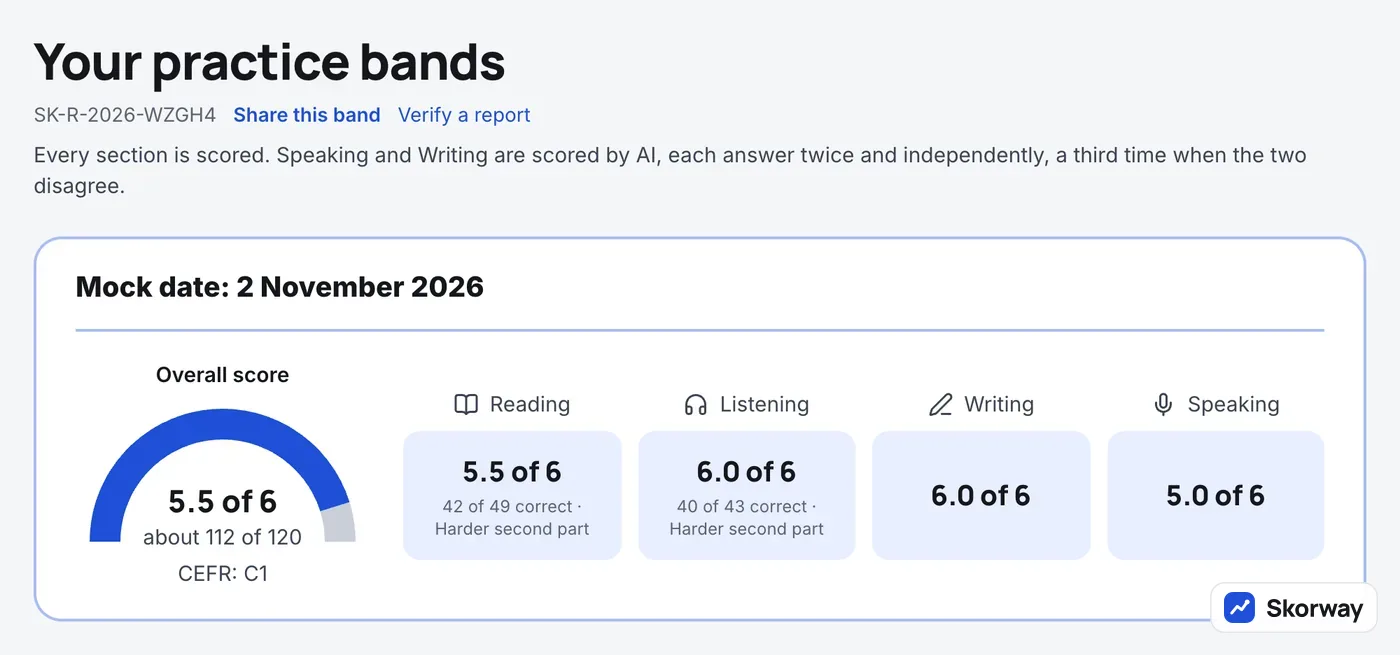
Reading a transcript is the easy version. Skorway's free Test Tour plays every Listening recording once, at your own pace, so you hear each task type before it counts. A mock plays the whole section as on test day: real voices, a clock on every question, no Back button, and a second part chosen by how you did on the first. The report lists every question you missed with your answer, the correct one and the reason, so you see which of the eight types costs you points. A few minutes after you finish you have a Listening band from 1 to 6 and a band for every other section. The Listening practice sets drill each task on its own, and the first two sets of every task type are free with an account.
Correct for the TOEFL iBT as it runs on November 7, 2026. The examples and the recording are Skorway's own, not ETS's.