TOEFL Listen and Choose a Response: how it works and the five traps, with a recording
TOEFL Listen and Choose a Response in 2026: one spoken line, four written replies, how it is scored, a recording to try once, and the five traps.
Updated 6 November 2026 · 7 min read
The short answer
Listen and Choose a Response is the first Listening task on the 2026 TOEFL® iBT. One person says one line, usually 4 to 12 words, which you hear once and never see. Four written replies are on the screen from the start, and you choose the one that fits best as an answer. Each item is 1 point, marked automatically. It is the most frequent Listening task: you answer 11 or 15 scored items, depending on which second part you are routed to.
What you see and hear
The screen title is "Choose the best response." The speaker's picture is on the left, and the four replies are on the right, already visible before the line plays. The line plays once, with no replay and no transcript. Then you choose, the question has its own short clock, and there is no going back. It is the first task in the section, and it sits between A1 and B2 on the CEFR scale: the language is everyday, and the difficulty is in hearing it once at natural speed.
The lines come from ordinary life, wider than campus: work, errands, travel, appointments, plans. About half are questions, wh-questions, yes/no questions and negative questions such as "Isn't the match on Sunday?", and the rest are suggestions or statements that need a reaction, such as "I can't make it on Thursday."
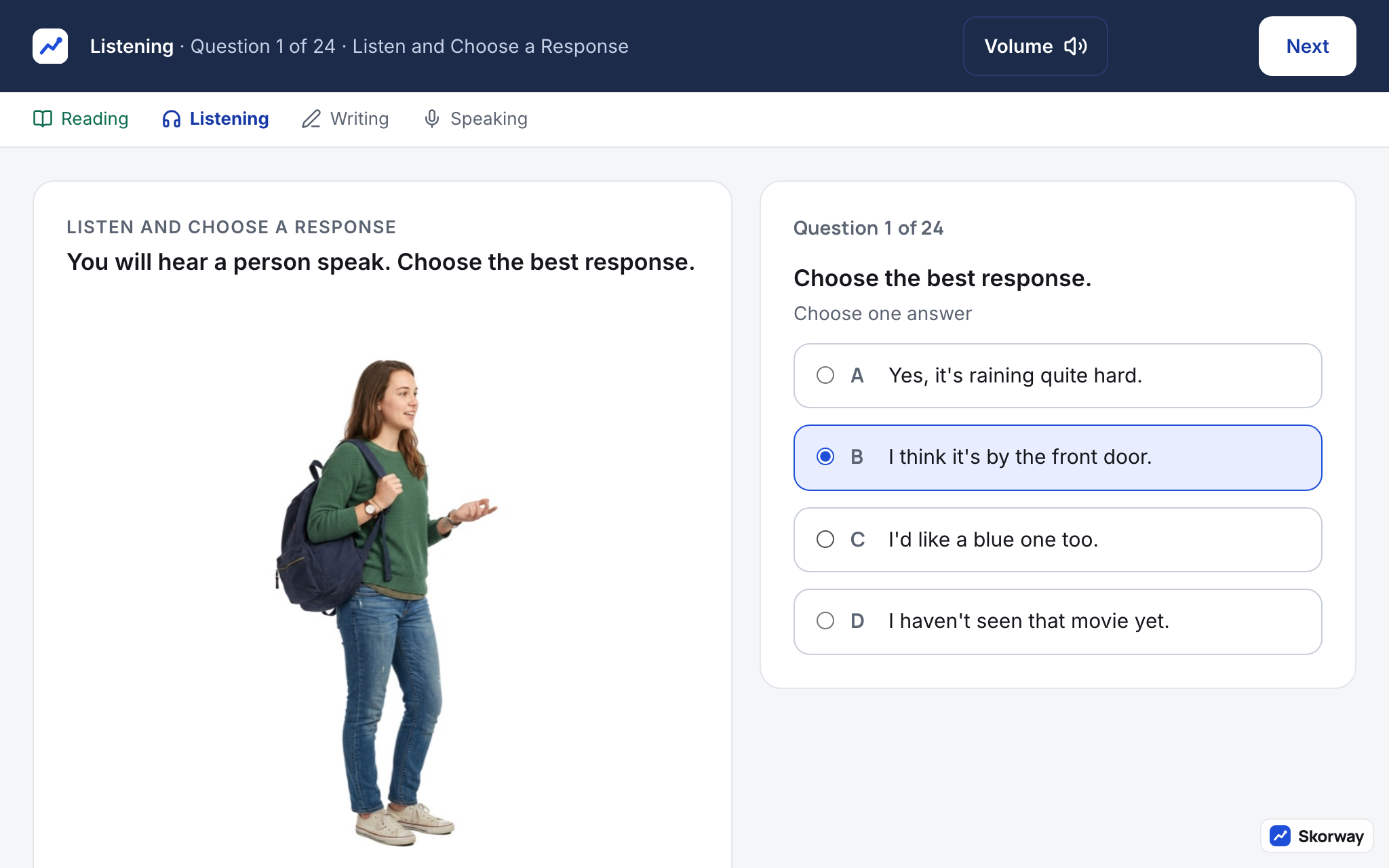
Try it
Read the four replies first, as you would on the test. Then press play: the recording plays once.
The five traps in the wrong replies
Every wrong reply is built on a pattern, and once you know the five, most items have one obvious key.
| Trap | The line | The wrong reply |
|---|---|---|
| The same word, another meaning | "Did you book the tickets?" | "I'm reading a good book." |
| An answer to a different question word | "What time does the meeting start?" | "In the main conference room." |
| The wrong form for the question | "Did you lock the door?" | "Yes, I would." |
| On topic, but not a reply | "When does her flight land?" | "The airport has a new parking garage." |
| The wrong social move | "Thanks for helping me move." | "No, I can't." |
The key itself is often indirect. A real reply to "Are you coming to the game on Saturday?" might be "Is it this Saturday?", "Actually, it was moved to Sunday" or "I wouldn't miss it." None of them says "yes" or "no", and all of them answer. That is what the task measures: whether you understood what the speaker meant, not whether you caught a word.
How it is scored
Each item is 1 point, marked automatically. Listening's first part has 8 scored items. The easier second part has 7 more, and the harder second part only 3, because it gives its time to academic talks. So the task is 11 or 15 of the 35 scored Listening points. The section has 15 to 19 of these items in all; the rest are unscored tryouts that sound exactly like the others. The Listening guide explains how the section becomes a band.
How to practise it
- Read the four replies before the line plays. You have them on screen from the start; use the seconds. Ask what kind of line each reply would answer.
- Listen for the first word. "What", "Who", "When", "Did", "Isn't", "Why don't we": the first word of the line tells you the kind of answer it needs, and rules out half the options.
- Distrust a reply that repeats a word you heard. The same word with another meaning is the commonest trap.
- Prefer the reply a person would actually say. If one option is a natural, slightly indirect answer and another is a grammatically neat but odd one, the natural one is usually the key.
- Practise with real speech, once. Podcasts and videos with short exchanges work well: pause after a question, say a reply out loud, then hear what the real speaker said.
See your Listening band before test day
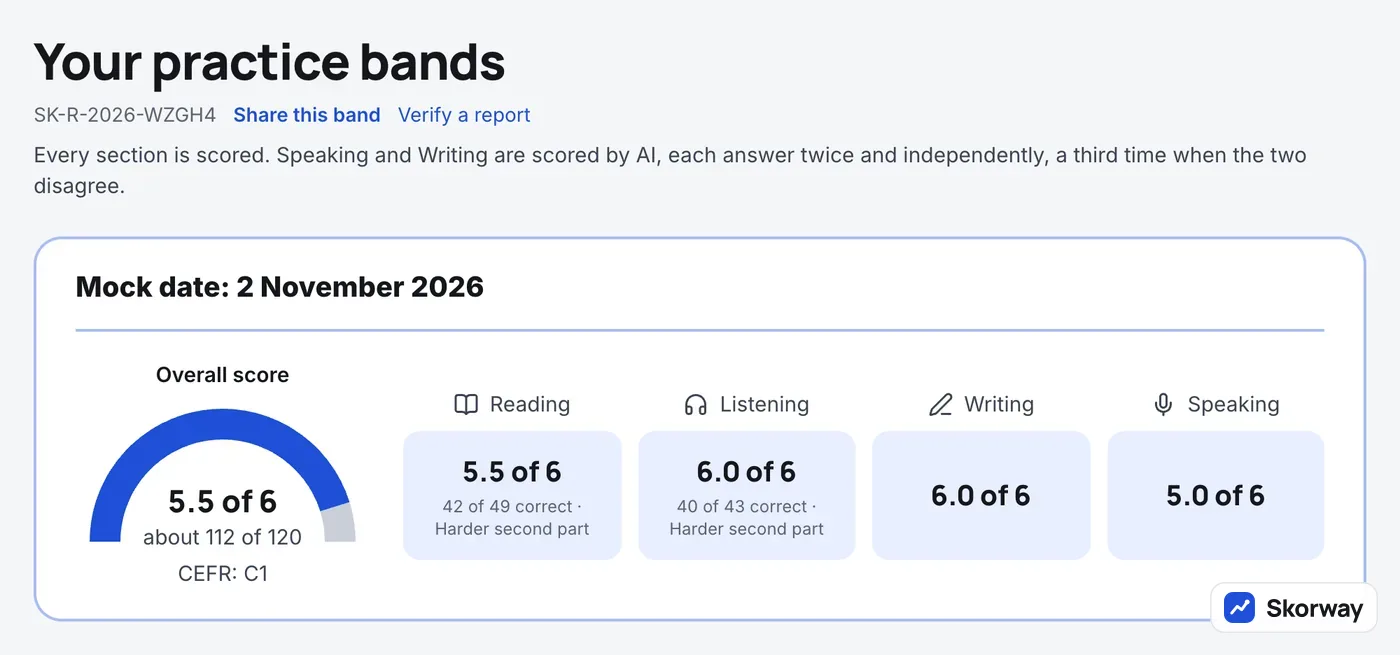
This task is up to 15 of the 35 points in Listening, and it is the one where hearing a line once, with no second chance, decides everything. Skorway's free mock is the full 2026 test, with every Listening line recorded in real voices and played once, the four replies on screen from the start, and the same first and second parts as the test. Listening is marked when the section ends, and a few minutes after the whole mock you have a band for every section, the part 2 you were routed to, and the three task types that cost you the most. The Listening practice sets have more items, and the first two sets of every task type are free. No credit card.
Is the spoken line shown on screen in Listen and Choose a Response?
No. You only hear it, once. Only the four replies are written.
Can I read the answer choices before the audio plays?
Yes. The four replies are on screen from the start, so read them before the line plays.
How many Listen and Choose a Response questions are on the TOEFL?
Eleven or fifteen that count: 8 in the first part, then 7 in the easier second part or 3 in the harder one. There are 15 to 19 in all, including unscored tryouts.
Correct for the TOEFL iBT as it runs on 6 November 2026. TOEFL® is a registered trademark of ETS. Skorway is not endorsed or approved by ETS.