TOEFL® score requirements at US universities in 2026, with 13 named schools
What US universities ask for on the TOEFL iBT in 2026, undergraduate and graduate, with the published minimums of MIT, Stanford, Columbia, Berkeley and nine more.
Updated November 17, 2026 · 9 min read
The short answer
There is no national TOEFL® minimum in the US: each university, and often each program, sets its own. On the 2026 scale, most published requirements fall between 4.5 and 5.5. Undergraduate admissions at selective universities mostly ask for a 5, the most selective for 5.5. Graduate schools set university-wide floors from 4 to 5, and departments can ask for more. On the old 0–120 scale, the same requirements read as about 80 to 105. Many pages now give both, one for tests before January 21, 2026 and one for tests from that date.
What 13 universities publish
These are the figures each university's own admissions page gives, recorded exactly as written, for the level shown. All were checked on November 9, 2026. A "minimum" is a cut-off; "recommended" and "competitive" figures are what the university says successful applicants tend to have.
| University and level | Tests before January 21, 2026 (0–120) | Tests on or after January 21, 2026 (1–6) | Sections and notes |
|---|---|---|---|
| MIT, undergraduate | Minimum 90, recommended 100 | Minimum 5, recommended 5.5 | |
| MIT, graduate | 100 minimum (recommended by Graduate Admissions) | 5 minimum (recommended by Graduate Admissions) | Department minimums take precedence |
| Stanford, graduate | 90 | 4.5 | Programs may set higher; 109 or 5.5 exempts you from Stanford's English placement test |
| Cornell, undergraduate | Minimum competitive score 100 (exams before January 2026) | Minimum 5.0, recommended 5.5 (exams January 2026 or later) | |
| Columbia, undergraduate | 105 (exams on or before January 20, 2026) | 5.5 | One test date only, no MyBest; Special Home Edition accepted |
| Penn, undergraduate | Competitive applicants tend to have 100 or above | Competitive applicants tend to have 5 or above | Consistency across the four sections; most recent test, no MyBest |
| Carnegie Mellon, undergraduate | At least 102 | At least 5 | Consideration to subscores of 25 and above (old) or 5 and above (new); iBT or Home Edition |
| UCLA, undergraduate | Above 100, with subscores above 24 | 5 or higher, with subscores of 5 or higher | Given as competitive scores |
| UC Berkeley, graduate (from Fall 2027) | 90 (tests from June 1, 2025 to January 20, 2026) | 5, with Speaking and Writing at least 4.5 | Home Edition accepted, MyBest not accepted |
| Duke, graduate | 90 (generally sought) | 5 (generally sought) | Average scores of admitted students are higher |
| Georgia Tech, graduate | 90, each section 19 or higher | 4.5; Reading 4, Listening 4, Writing 4, Speaking 3.5 | Test center or Home Edition; programs may require more |
| Illinois Urbana-Champaign, graduate | Full status 103; limited status 79 | Full status 5.0; limited status 4.0 | Below full status means an English placement test; Home Edition accepted, MyBest not accepted |
| University of Washington, graduate | Minimum 80, recommended 92 | Minimum 4.0, recommended 4.5 or higher | MyBest listed at 80 and 92; some programs may not accept it |
| Notre Dame, graduate | 80, Speaking at least 23 (pre-February 2026 scoring) | 4.5 average, no section below 4.0 | Some programs may require higher |
| Notre Dame, undergraduate | 100, Speaking at least 25 (strongly recommended) | 5.5 average, no section below 5.0 (strongly recommended) | Special Home Edition not accepted |
Departments within one university differ, and pages change between application cycles. Use the table to see the range, then read the page for your own program before you plan a test date.
What is the minimum TOEFL score required for admission to US universities?
There is no single one. In the table above:
- Undergraduate: 5 is the usual minimum or competitive figure (MIT, Cornell, Carnegie Mellon, UCLA, Penn). Columbia asks for 5.5, and Cornell, MIT and Notre Dame recommend 5.5.
- Graduate, university-wide: 4.5 at Stanford, Georgia Tech and Notre Dame; 5 at Berkeley, Duke, MIT and for full status at Illinois; 4.0 as the University of Washington's minimum.
- Graduate, by department: often higher than the university floor. MIT states it outright: department minimums take precedence.
Some graduate schools also admit students below the full requirement on condition that they take English classes, as Illinois does with its limited status. Our guide to good band scores explains what 4, 4.5, 5 and 5.5 mean in practice.
Reading a 0–120 minimum against a 2026 band
A test taken from January 21, 2026 gives you a band from 1 to 6, so a requirement written as "100" needs translating. The official concordance gives the lowest old total for each band:
| Band | Old total (from) | CEFR |
|---|---|---|
| 5.5 | 107 | C1 |
| 5 | 95 | C1 |
| 4.5 | 86 | B2 |
| 4 | 72 | B2 |
The guidance for institutions, followed in the usual way, turns an old 80 into a 4, 90 into a 4.5, 100 into a 5 and 110 into a 5.5. The table above shows that universities do not all follow it:
- An old 90 became 4.5 at Stanford and Georgia Tech, but 5 at Berkeley and Duke.
- An old 80 became 4.0 at the University of Washington, but 4.5 at Notre Dame's Graduate School.
- Old minimums of 102, 103 and 105 became 5 at Carnegie Mellon, 5 at Illinois and 5.5 at Columbia.
So if a program page gives only an old number, do not convert it yourself and assume the result. Email the admissions office and ask which band they accept. The score converter shows where an old total lands, and our score converter guide works through 80, 90 and 100.
Section minimums
More universities now set a minimum for each section as well as the overall band. In the table, Georgia Tech, Berkeley, Notre Dame and UCLA do; Carnegie Mellon gives subscores "consideration"; Penn looks for consistency across the four.
Section minimums change how you should read your own score. The overall band is the average of the four sections, rounded to the nearest half band, so an overall 5 can hide a Speaking 4.5. At Berkeley, that can pass, because the Speaking minimum is 4.5. At Notre Dame's undergraduate admissions, the recommendation is no section below 5.0, and the same report falls short.
On the old scale, sections were scored from 0 to 30, and the same old number did not always mean the same band: a 24 is a 5 in Reading but a 4.5 in Speaking. Our guide to the band scale has the section-by-section table.
Do US universities accept MyBest scores?
MyBest scores combine your best score in each section from all your valid tests in the last two years. Universities decide whether they count them, and in this table more say no than yes: Columbia, Penn, Berkeley and Illinois do not accept them, and the University of Washington lists them with a note that some programs may not. Where a page says nothing, check with each school before you plan on combining sections from two test dates.
Do US universities accept the TOEFL Home Edition?
The Home Edition is the same test taken at home with a live proctor. Berkeley, Georgia Tech, Illinois and Carnegie Mellon name it as accepted, and Columbia accepts the Special Home Edition. Notre Dame's undergraduate admissions does not accept the Special Home Edition. Most pages say nothing either way, so check with each school; our Home Edition guide covers the rules if you choose it.
Sending scores
Most universities want an official score report sent by ETS, using their institution code, which is usually on the same admissions page. Codes published on the pages in the table include Cornell 2098, Columbia 2116, Carnegie Mellon 2074, Notre Dame 1841, Georgia Tech 5248 (Graduate), Illinois 1836 and Duke Graduate School 5156. Some undergraduate systems work differently: UCLA asks you to self-report your scores on the UC application, and a TOEFL score sent to one UC campus reaches every campus you apply to.
Your test fee covers reports to up to four institutions named before the test. Naming any institution closes the option of a Speaking or Writing score review, and a report takes 4 to 10 business days to arrive electronically after the scores are posted. A score is valid for two years from the test date, and some universities want it still valid on the deadline or on the first day of term, not only on the day you apply. Our guide to TOEFL score validity covers both.
Is 4.5 enough for a US university?
For many graduate programs, yes: Stanford, Georgia Tech and Notre Dame's Graduate School set 4.5 as their university-wide minimum, and it is the University of Washington's recommended score. For selective undergraduate admissions, usually not; most of the universities in the table ask for 5 or more.
Do US universities accept the new TOEFL scores?
Yes. Every university in the table lists a requirement for tests taken on or after January 21, 2026, on the 1–6 scale.
Find your band before you pick your schools
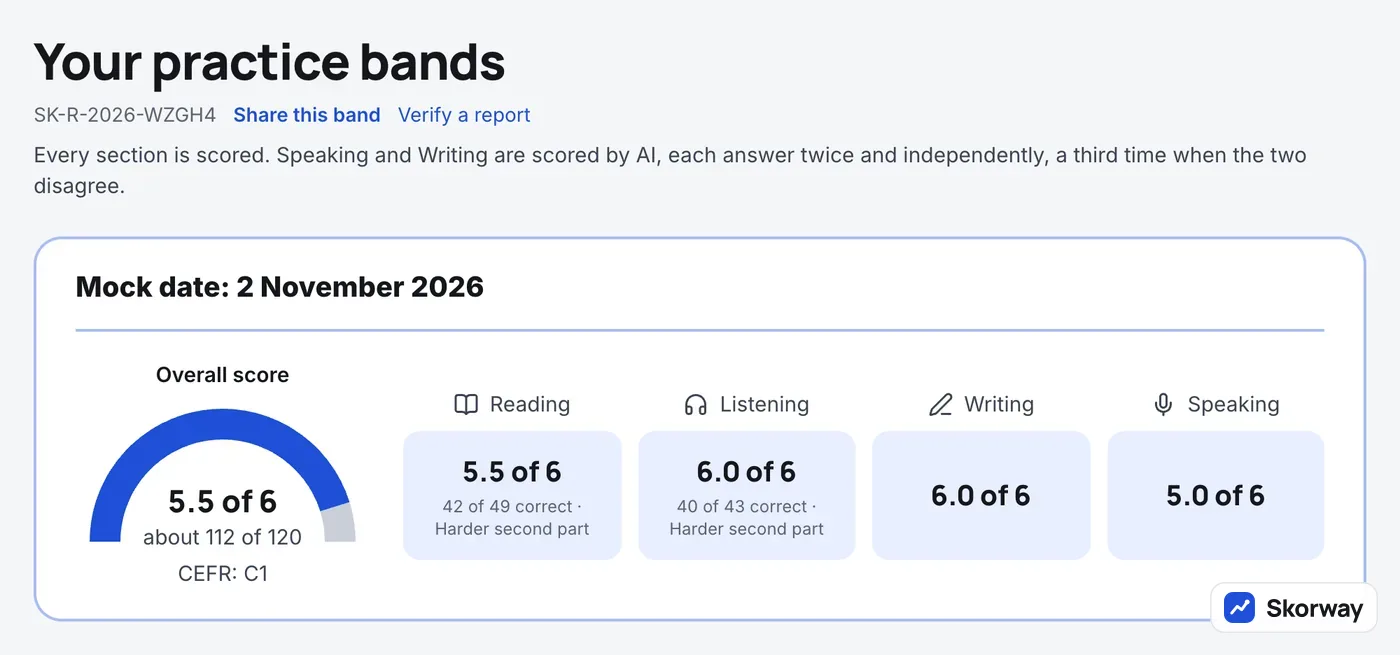
A list of requirements is only useful once you know your own band. A Skorway mock is the full 2026 test, all four sections with the real timers, and within minutes it gives you a band for every section, an overall band and a 0 to 120 estimate, so you can read it against a page written in either scale and against every section minimum in this table. If you are at 4.5 and your list runs from Stanford to Columbia, you will know which schools you meet today and which section needs the next weeks. Every Speaking and Writing answer comes back marked up and rewritten one band higher. One mock is US$4.99, and the free Test Tour is the whole TOEFL test at your own pace, if you want to see it first.
Correct for the TOEFL iBT as it runs on November 17, 2026.